In today’s connected world, people can watch the same movies, use the same smartphones, and scroll through the same social media platforms — yet their monthly earnings can be drastically different depending on where they live.
A software engineer in Switzerland may earn more in a week than some workers in developing countries earn in an entire year. Meanwhile, rising inflation, housing costs, and economic inequality continue to shape how far salaries actually go in each country.
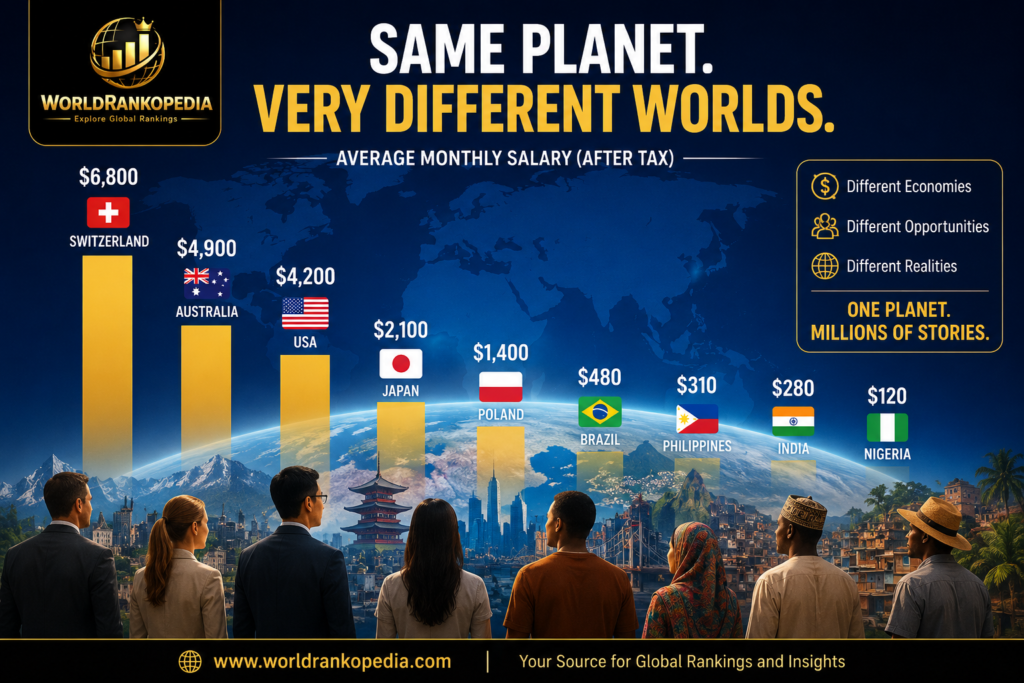
This comparison of average monthly salaries after tax highlights the massive gap between developed and developing economies. While income is not the only measure of quality of life, it remains one of the clearest indicators of economic opportunity, living standards, and financial stability.
Here’s a look at the average monthly salaries in selected countries during 2026.
Average Monthly Salaries After Tax (2026)
| Country | Average Monthly Salary (After Tax) |
|---|---|
| 🇨🇭 Switzerland | $6,800 |
| 🇦🇺 Australia | $4,900 |
| 🇺🇸 USA | $4,200 |
| 🇯🇵 Japan | $2,100 |
| 🇵🇱 Poland | $1,400 |
| 🇧🇷 Brazil | $480 |
| 🇵🇭 Philippines | $310 |
| 🇮🇳 India | $280 |
| 🇳🇬 Nigeria | $120 |
🇨🇭 Switzerland – The Highest Earner in This List
Switzerland consistently ranks among the world’s wealthiest countries, and its salaries reflect that strength. With an average monthly salary of around $6,800 after tax, Swiss workers enjoy some of the highest incomes globally.
The country benefits from a strong banking sector, pharmaceutical industry, advanced manufacturing, and political stability. However, Switzerland is also one of the most expensive places to live. Rent, healthcare, transportation, and food costs are extremely high, especially in cities like Zurich and Geneva.
Still, even after accounting for expenses, many Swiss residents maintain a high standard of living.
🇦🇺 Australia – High Wages and Strong Living Standards
Australia offers one of the strongest salary structures in the world, with average monthly earnings reaching nearly $4,900 after tax.
The country’s economy is powered by mining, finance, healthcare, education, and technology. Australia also maintains a relatively high minimum wage compared to many countries.
Although housing prices in Sydney and Melbourne have become expensive, Australians generally enjoy excellent public services, healthcare, work-life balance, and employment protections.
🇺🇸 United States – High Income, High Expenses
The United States remains one of the largest economies in the world, with average monthly take-home salaries around $4,200.
American workers in industries such as technology, finance, medicine, and engineering can earn significantly higher than the national average. However, the U.S. also faces major income inequality.
Healthcare costs, student debt, insurance, and housing expenses can consume a large portion of salaries. Despite high incomes, many Americans still struggle with the rising cost of living.
🇯🇵 Japan – Stable Economy, Moderate Salaries
Japan’s average after-tax monthly salary stands at approximately $2,100.
As one of Asia’s most advanced economies, Japan is known for innovation, manufacturing, robotics, and global brands. However, wage growth in Japan has remained relatively slow over the past two decades.
While salaries may appear lower compared to Western countries, Japan offers strong infrastructure, public transportation, safety, and healthcare systems that help maintain a comfortable lifestyle for many citizens.
🇵🇱 Poland – Europe’s Rising Economic Power
Poland has become one of Europe’s fastest-growing economies in recent years. Average monthly salaries after tax now reach around $1,400.
The country has experienced major development in technology, manufacturing, logistics, and outsourcing industries. Many international companies are investing heavily in Poland due to its skilled workforce and growing economy.
Compared to Western Europe, living costs in Poland are lower, allowing many residents to maintain decent purchasing power despite smaller salaries.
🇧🇷 Brazil – Economic Potential with Financial Challenges
Brazil is Latin America’s largest economy, yet the average monthly salary after tax remains around $480.
Economic instability, inflation, unemployment, and political uncertainty have affected income growth in recent years. Large differences also exist between urban and rural regions.
Despite these challenges, Brazil continues to have strong industries in agriculture, mining, energy, and manufacturing. Many young professionals are also entering the growing digital economy.
🇵🇭 Philippines – Growing Workforce, Lower Income Levels
The Philippines has one of the youngest and fastest-growing populations in Asia. The average monthly after-tax salary is approximately $310.
The country relies heavily on the service sector, the outsourcing industry, overseas remittances, and tourism. While salaries remain relatively low, the Philippines has become a global hub for customer support and remote work services.
Lower living costs help many families manage daily expenses, but rising food and housing prices continue to create financial pressure.
🇮🇳 India – Huge Workforce, Massive Income Gap
India’s average monthly salary after tax is estimated at around $280, though earnings vary greatly depending on region, education, and profession.
India has one of the world’s largest labour forces and a rapidly expanding economy driven by technology, manufacturing, startups, and services. Cities like Bengaluru, Mumbai, and Hyderabad have become major global tech centres.
However, income inequality remains significant. While some professionals earn world-class salaries, millions of workers still earn modest wages, especially in rural areas.
🇳🇬 Nigeria – Africa’s Largest Population Faces Economic Pressure
Nigeria records the lowest average salary on this list at approximately $120 per month after tax.
Despite being rich in oil and natural resources, Nigeria faces serious economic challenges, including inflation, unemployment, currency instability, and infrastructure problems.
Many Nigerians rely on small businesses, informal work, and freelance opportunities to support their families. However, the country’s young population and growing digital sector continue to offer future potential.
Why Salaries Differ So Much Between Countries
Several factors influence how much people earn around the world:
Economic Strength
Countries with stronger economies usually generate higher-paying jobs and better employment opportunities.
Education and Skills
Highly educated workforces often attract industries that pay better salaries.
Cost of Living
If the country’s inflation rate is low, then A salary that seems small in one country may still provide a comfortable lifestyle due to lower expenses.
Currency Value
Exchange rates can have a huge impact on how salaries appear in U.S. dollars.
Government Policies
Labour laws, taxation, minimum wages, and worker protections all affect income levels.
Salary Alone Does Not Tell the Full Story
Although Switzerland and Australia offer extremely high salaries, they also have some of the world’s highest living costs.
Meanwhile, countries with lower salaries may still provide affordable housing, cheaper transportation, and lower daily expenses.
Quality of life depends on many things beyond income, including:
- Healthcare
- Safety
- Education
- Work-life balance
- Housing affordability
- Public services
- Economic stability
This is why salary comparisons should always be viewed alongside living costs and purchasing power.
The Global Income Gap Continues to Grow
The difference between high-income and low-income nations remains enormous in 2026. A worker in Switzerland earns more in one month than many workers in Nigeria earn in several years.
Technology and globalisation have connected the world more than ever before, but economic inequality still shapes opportunities, lifestyles, and futures for billions of people.
As developing economies continue to grow, many experts believe global wages will gradually rise over time. However, closing the income gap remains one of the biggest economic challenges of the modern era.
Final Thoughts
These salary figures reveal a simple but powerful reality: people may share the same planet, but they live in very different financial worlds.
From the high-paying economies of Switzerland, Australia, and the United States to the lower-income struggles faced in parts of Asia, Africa, and Latin America, income differences continue to define living standards across the globe.
Understanding these economic contrasts helps us better appreciate the challenges and opportunities people face in different countries every single day.
Published by:
WorldRankopedia