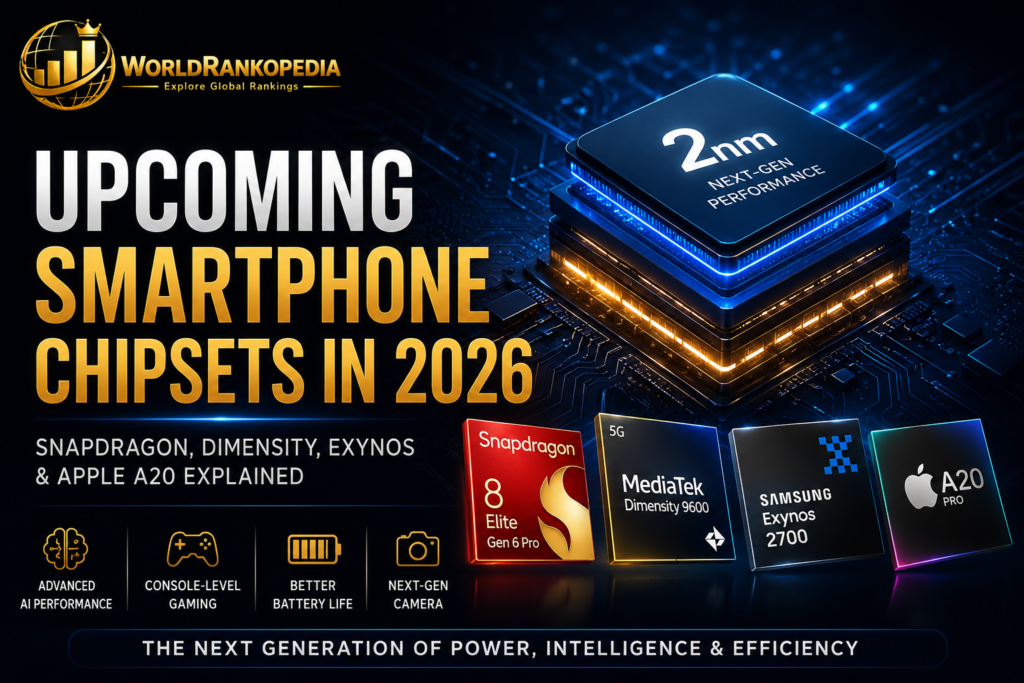
The smartphone industry is gearing up for a significant jump in performance and efficiency as the next generation of mobile chipsets moves toward 2nm and improved 3nm manufacturing technologies. Companies like Qualcomm, MediaTek, Samsung, and Apple are already developing their new flagship processors to power premium smartphones in 2026 and beyond. From faster AI processing and console-level gaming to better battery life and improved camera capabilities, these new chipsets are expected to redefine the smartphone experience.
In this article, we will explore the upcoming Snapdragon, MediaTek Dimensity, Samsung Exynos, and Apple Bionic chips that are rumoured to launch soon.
Why 2nm Chips Matter
The transition from 3nm to 2nm fabrication is one of the biggest upgrades in semiconductor history. Smaller transistor sizes allow manufacturers to place more transistors inside the same chip area, which leads to:
- Better performance
- Lower power consumption
- Improved battery life
- Less heat generation
- Faster AI computations
- Better gaming efficiency
In simple words, 2nm chips can deliver more power while using less energy.
Upcoming Qualcomm Snapdragon Chips
Qualcomm continues to dominate the Android flagship market with its Snapdragon series. The company is reportedly preparing multiple next-generation processors.
Snapdragon 8 Elite Gen 6 Pro – 2nm
The Snapdragon 8 Elite Gen 6 Pro is expected to become Qualcomm’s most powerful mobile chipset ever. Built on a cutting-edge 2nm process, this processor could provide big improvements in CPU speed, GPU graphics, and AI capabilities.
Expected Features
- Advanced AI engine
- Desktop-level gaming performance
- Improved thermal management
- Better camera image processing
- Longer battery efficiency
This chipset may power premium flagship phones from Samsung, Xiaomi, OnePlus, ASUS, and other major brands.
Snapdragon 8 Elite Gen 6 – 2nm
The standard Snapdragon 8 Elite Gen 6 is also rumoured to use the same 2nm technology but with slightly lower clock speeds compared to the Pro model. It is expected to focus on:
- High-end gaming
- AI-powered photography
- Faster app performance
- Improved 5G connectivity
This processor could become the mainstream flagship chip for Android devices in 2026.
Snapdragon 8 Elite Gen 5 Pro – 3nm
Before the complete transition to 2nm, Qualcomm may continue using an optimised 3nm architecture for the Snapdragon 8 Elite Gen 5 Pro. Even though it uses 3nm technology, it is still expected to provide:
- Excellent gaming performance
- Efficient multitasking
- Better cooling systems
- Advanced AI processing
Snapdragon 8 Gen 6 – 3nm
The Snapdragon 8 Gen 6 could become the successor to current flagship Snapdragon processors and may focus on balancing performance and efficiency. Possible improvements include:
- Faster GPU rendering
- Better battery optimization
- Stronger AI tools
- Enhanced mobile photography
Upcoming MediaTek Dimensity Chips
MediaTek has become a strong competitor in the flagship chipset market. Its Dimensity series now provides there hardwere to many premium smartphones globally.
MediaTek 9600 Pro – 2nm
The Dimensity 9600 Pro is rumoured to be MediaTek’s first 2nm flagship chipset. Expected highlights:
- Massive AI performance boost
- Faster gaming frame rates
- Better power efficiency
- Advanced ray tracing support
MediaTek is focusing heavily on gaming smartphones and AI-driven features with this processor.
MediaTek 9600 – 2nm
The standard Dimensity 9600 may offer flagship-level performance at a more affordable price. Expected benefits:
- Premium gaming experience
- Improved battery life
- Better multitasking
- High-speed 5G performance
This chipset could appear in phones from Vivo, Oppo, Realme, and Redmi.
MediaTek 9600s – 3nm
The Dimensity 9600s may serve as a slightly toned-down flagship processor using mature 3nm technology. Possible advantages:
- Better efficiency
- Lower smartphone prices
- Reliable performance
- Improved thermal stability
MediaTek 8600 – 3nm
The Dimensity 8600 could target upper mid-range smartphones with flagship-like performance. This chipset may deliver:
- Smooth gaming
- AI-enhanced cameras
- Efficient multitasking
- Better connectivity
Samsung Exynos 2700 –2 nmm
Samsung is also expected to enter the 2nm race with the upcoming Exynos 2700 chipset. The Exynos series has improved significantly in recent years, especially in graphics performance and thermal management.
Rumored Features
- Advanced AMD-powered GPU
- Better gaming optimization
- AI-enhanced image processing
- Improved battery efficiency
- Faster processing speeds
Samsung may use this chipset in selected Galaxy flagship smartphones depending on the region.
Apple Bionic A20 & A20 Pro – 2nm
Apple is reportedly preparing the A20 and A20 Pro chipsets using 2nm fabrication technology. Apple’s processors are already considered among the fastest in the world, and the move to 2nm could widen the performance gap even further.
Expected Improvements
- Faster iPhone performance
- Better AI processing
- Longer battery life
- Improved graphics rendering
- More efficient machine learning
These processors are likely to power future iPhone models and advanced Apple devices.
AI Will Be the Biggest Focus
One major trend among all upcoming chipsets is Artificial Intelligence. Future processors will heavily focus on:
- AI photo editing
- Real-time language translation
- Smart voice assistants
- On-device AI generation
- Advanced gaming AI
- Faster video rendering
Instead of relying completely on cloud servers, smartphones will perform more AI tasks directly on the device.
Gaming Performance Is Reaching Console Level
Mobile gaming and esports are becoming more demanding every year. Upcoming flagship chipsets are expected to support:
- Hardware ray tracing
- Higher FPS gaming
- Better GPU cooling
- Advanced graphics rendering
- Improved touch response
This means future smartphones could deliver gaming experiences close to handheld gaming consoles.
Better Battery Life Despite Higher Performance
Usually, more performance means more battery usage. However, the move to 2nm technology changes that equation. Because 2nm chips are more power-efficient, users may experience:
- Longer screen-on time
- Faster charging optimization
- Less overheating
- Better standby battery life
This could become one of the biggest improvements in future smartphones.
Which Brand Could Lead the Market?
Each company has its own strengths:
| Brand | Strongest Area |
|---|---|
| Qualcomm Snapdragon | Gaming & balanced flagship performance |
| MediaTek Dimensity | Value-for-money flagship chips |
| Samsung Exynos | Graphics and ecosystem integration |
| Apple Bionic | Raw performance and efficiency |
The competition between these companies will benefit consumers by bringing faster and smarter smartphones.
Final Thoughts
The upcoming generation of Snapdragon, MediaTek Dimensity, Samsung Exynos, and Apple Bionic chipsets marks the beginning of a new era in mobile technology. The shift toward 2nm architecture could deliver breakthroughs in AI, gaming, battery efficiency, and overall smartphone performance. As smartphone companies continue pushing innovation, users can expect devices that are faster, smarter, cooler, and more power-efficient than ever before. The chipset war of 2026 is shaping up to be one of the most exciting battles in smartphone history, and the future of mobile computing looks incredibly powerful.