Commercial aviation has revolutionised global travel. Today’s passenger aircraft are faster, safer, and more comfortable, with some models carrying hundreds of travellers per flight.
Airlines prioritise seating capacity to reduce per-passenger costs and boost efficiency. Airbus and Boeing have long competed to build large, comfortable, and safe aircraft.
In this article, we explore some of the world’s largest passenger aircraft and their total seating capacities.
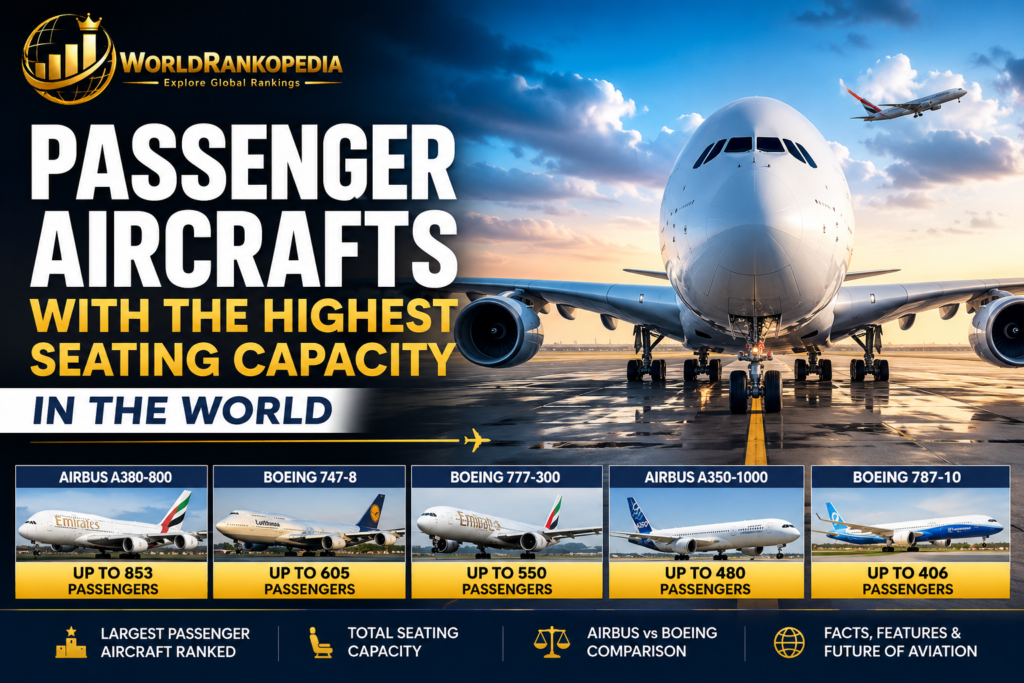
1. Airbus A380-800
Total Seating Capacity: Up to 853 Passengers
The Airbus A380 is officially the largest passenger aircraft ever built. Designed by European aerospace giant Airbus, this double-deck superjumbo completely changed the aviation industry when it entered service in 2007.
The aircraft became famous for its luxurious cabins, quiet interior, and massive size. Airlines such as Emirates, Singapore Airlines, and Qatar Airways use the A380 for long-haul international routes.
Although most airlines configure the A380 with around 500 to 600 seats for better passenger comfort, the aircraft is certified to carry a maximum of 853 passengers in an all-economy configuration.
Key Features
- Full-length double deck
- Four powerful engines
- Extremely quiet cabin
- Advanced lighting and air circulation systems
- Luxurious first-class suites and onboard lounges
The Airbus A380 remains one of the most iconic aircraft in aviation history despite Airbus ending production in 2021.
2. Boeing 747-8
Total Seating Capacity: Up to 605 Passengers
The Boeing 747-8 is the latest and largest version of the legendary Boeing 747 family. Often called the “Queen of the Skies,” the 747 series dominated long-haul aviation for decades.
The 747-8 offers improved fuel efficiency, quieter engines, and a longer fuselage compared to older 747 models. In high-density layouts, it can accommodate up to 605 passengers.
Key Features
- Distinctive hump-shaped upper deck
- Long-range international capability
- Advanced aerodynamic wings
- Improved fuel efficiency over older models
Although newer twin-engine aircraft are becoming more popular, the Boeing 747-8 remains a symbol of prestige and power in aviation.
3. Boeing 777-300
Total Seating Capacity: Up to 550 Passengers
The Boeing 777-300 is among the most successful wide-body aircraft ever produced. Airlines love this aircraft because it combines large seating capacity with strong fuel efficiency.
In maximum-density seating arrangements, the Boeing 777-300 can carry up to 550 passengers.
Key Features
- Twin-engine wide-body design
- Long-haul flight capability
- Spacious cabin layout
- Lower operating costs compared to four-engine aircraft.
Emirates is currently one of the world’s largest operators of the Boeing 777 family.
4. Boeing 747-400
Total Seating Capacity: Up to 660 Passengers
Before the Airbus A380 arrived, the Boeing 747-400 was one of the largest passenger aircraft in the world. This aircraft became a favourite for international airlines during the 1990s and early 2000s.
Depending on seating configuration, the aircraft can carry up to 660 passengers in all-economy layouts.
Key Features
- Long-distance flight range
- Reliable four-engine performance
- Massive cargo and passenger capability
- Famous upper-deck design
The Boeing 747-400 helped shape global air travel for decades and remains a historic aircraft in commercial aviation.
5. Airbus A350-1000
Total Seating Capacity: Up to 480 Passengers
The Airbus A350-1000 is one of the most advanced passenger aircraft in service today. Built mainly from lightweight composite materials, the aircraft delivers excellent fuel efficiency and passenger comfort.
The aircraft can carry up to 480 passengers, depending on the airline’s configuration.
Key Features
- Carbon-fiber construction
- Reduced fuel consumption
- Ultra-modern cockpit technology
- Quiet and comfortable cabin
Many airlines consider the A350-1000 the future of long-haul travel.
6. Airbus A340-600
Total Seating Capacity: Up to 475 Passengers
The Airbus A340-600 was designed to compete with Boeing’s large aircraft in the early 2000s. Known for its extremely long fuselage, it remains one of the longest passenger aircraft ever built.
The aircraft can carry up to 475 passengers in high-capacity layouts.
Key Features
- Four-engine design
- Long-range capability
- Spacious cabin
- Smooth and stable flights
Although production has ended, several airlines still operate the A340-600 today.
7. Boeing 777-9
Total Seating Capacity: Around 450 Passengers
The Boeing 777-9, part of the new 777X family, is Boeing’s next-generation long-haul aircraft designed to compete with Airbus models.
It is expected to carry around 426 to 450 passengers while offering excellent fuel efficiency.
Key Features
- Folding wingtips
- Advanced fuel-saving engines
- Modern passenger cabin
- Longer range capability
The aircraft is expected to play a major role in future international aviation.
8. Boeing 787-10 Dreamliner
Total Seating Capacity: Up to 406 Passengers
The Boeing 787-10 is the largest variant of the Dreamliner family. It is highly popular among airlines because of its fuel efficiency and passenger comfort.
The aircraft can carry more than 400 passengers in maximum-capacity layouts.
Key Features
- Large electronically dimmable windows
- Better cabin humidity
- Reduced jet lag for passengers
- Lightweight composite structure
The Dreamliner family is considered one of Boeing’s greatest technological achievements.
Why Seating Capacity Matters in Aviation
Passenger seating capacity directly affects airline profitability. Larger aircraft help airlines:
- Reduce ticket costs per passenger.
- Transport more travellers on busy routes.
- Improve airport slot efficiency.
- Increase revenue potential
However, very large aircraft also come with challenges. Airlines must fill enough seats to remain profitable, which is one reason why many modern airlines now prefer fuel-efficient twin-engine aircraft over giant four-engine jets.
The Future of Large Passenger Aircraft
The aviation industry is moving toward more fuel-efficient and environmentally friendly aircraft. While giant aircraft like the Airbus A380 remain engineering masterpieces, airlines are increasingly choosing modern twin-engine jets such as the Airbus A350 and Boeing 787.
Future aircraft will likely focus more on:
- Fuel efficiency
- Lower carbon emissions
- Passenger comfort
- Long-range direct flights
- Advanced lightweight materials
Even though some superjumbo aircraft are disappearing from production lines, they will always remain legendary symbols of aviation history.
Final Thoughts
Passenger aircraft have become one of humanity’s greatest engineering achievements. From the iconic Boeing 747 to the enormous Airbus A380, these flying giants connect millions of people around the world every single day.
The Airbus A380 currently holds the record as the world’s largest passenger aircraft with a maximum seating capacity of 853 passengers. Meanwhile, modern aircraft like the Boeing 777X and Airbus A350 are shaping the future of commercial aviation with better efficiency and smarter technology.
As aviation continues to evolve, passengers can expect even more advanced aircraft that combine massive capacity, comfort, and sustainability in the years ahead.