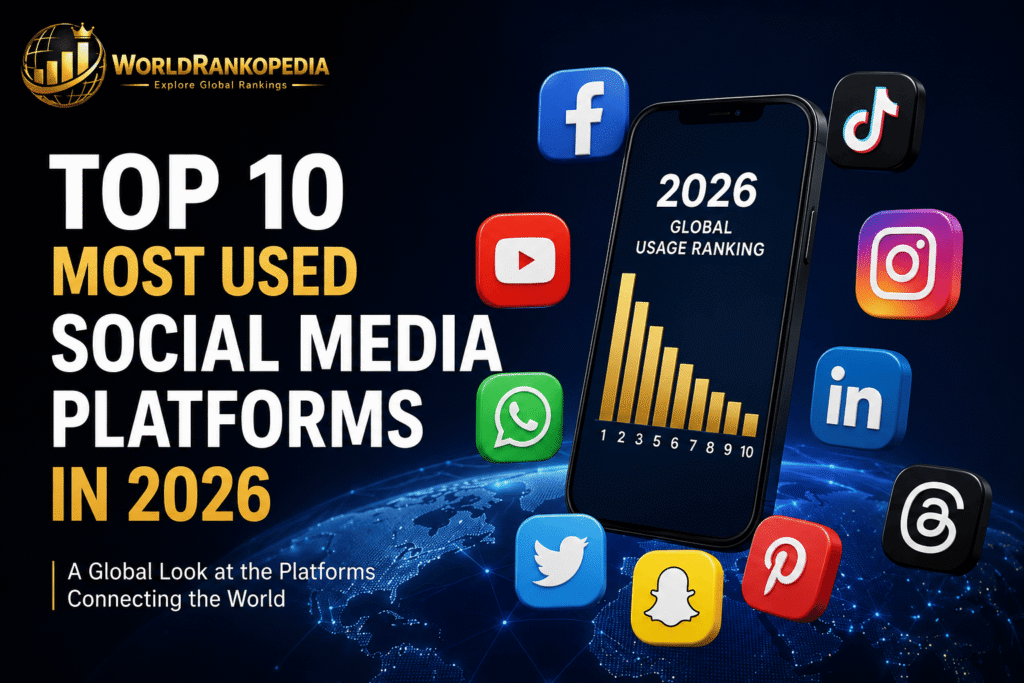
Think about the last 30 minutes of your life. Did you scroll through a feed, send a voice note, watch a short video, or catch up on the news through a post? If you did any of those things — welcome to the club that now includes over 5.7 billion people worldwide.
Social media in 2026 is no longer just an app you open out of boredom. It is where careers are built, businesses grow, revolutions are sparked, and — let’s be honest — where most of us waste a perfectly good hour before bed. The platforms leading this digital world have grown into ecosystems of their own, each with its own culture, language, and purpose.
So which ones are actually winning the attention game in 2026? Let’s break it down — no fluff, just real numbers and real context.
1. Facebook — 3.1 Billion Monthly Active Users
Nobody predicted that the platform launched in a Harvard dorm room back in 2004 would still be sitting at the top of the global charts more than two decades later. Yet here we are.
Facebook remains the most-used social media platform on the planet, with over 3.1 billion monthly active users — a number that represents roughly 40% of the entire world’s population. Think about that for a second. Nearly half the people alive open Facebook at least once a month.
Its dominance isn’t accidental. Facebook has evolved far beyond a place to share status updates. Today it powers local communities through Groups, drives e-commerce through Marketplace, and connects families across continents through Messenger. The 25–34 age group makes up its most active segment, and these users aren’t just scrolling — they’re buying. Around 39% of consumers report making a purchase directly through Facebook, making it one of the most commercially powerful platforms alive.
Is it as “cool” as it once was among teenagers? Probably not. But cool and dominant are two very different things.
2. WhatsApp — 3 Billion Monthly Active Users
If Facebook is the town square, WhatsApp is the kitchen table — where the real conversations happen.
With 3 billion monthly active users, WhatsApp has grown from a simple messaging app into one of the most essential communication tools in the world. In countries like India, Brazil, Nigeria, and across most of Southeast Asia and the Middle East, it isn’t just popular — it’s practically infrastructure.
What makes WhatsApp different from other platforms is its intimacy. There’s no algorithm deciding what you see. There’s no feed to scroll. It’s just people talking to people, in real time, with end-to-end encryption that keeps those conversations private. Businesses have caught on too, using WhatsApp Business tools to handle customer service, send order updates, and build one-on-one relationships with customers at scale.
The average WhatsApp user spends about an hour a day inside the app — which says a lot about how embedded it’s become in daily life.
3. Instagram — 3 Billion Monthly Active Users
Instagram turned a simple idea — share beautiful photos — into one of the most powerful visual culture engines ever created.
Sitting alongside WhatsApp at 3 billion monthly active users, Instagram is where aesthetics meet influence. From fashion and food to fitness and finance, virtually every niche has found a home here. The platform’s evolution through Stories, Reels, and shopping integrations has kept it feeling fresh even as newer competitors have emerged.
In the United States alone, Instagram reaches around 148 million users monthly. What’s particularly remarkable is how deeply it has shaped creator culture. The term “influencer” is practically an Instagram invention, and the platform continues to be the go-to destination for brands looking to reach aspirational, visually engaged audiences.
Reels — Instagram’s answer to TikTok’s short-form video format — have become one of the platform’s biggest growth drivers. If you’ve noticed your feed looking more like a video player lately, that’s entirely intentional.
4. YouTube — 2.5 Billion Monthly Active Users
YouTube occupies a unique space in this list. Depending on how you measure “most used,” it could arguably sit even higher.
With 2.5 billion monthly active users and users spending an average of one hour and 24 minutes daily on the platform, YouTube commands more total watch time than almost any other app on the planet. Research from DataReportal suggests that when measuring actual active usage on Android devices, YouTube’s audience may be even larger than its official monthly figures suggest — with over 50% more total watch time than WhatsApp and nearly double that of TikTok.
The platform has become the world’s second-largest search engine after Google (which, of course, owns it). People don’t just go to YouTube for entertainment — they go to learn. From cooking tutorials to university-level courses, DIY home repairs to medical explanations, YouTube has become the internet’s library of moving images.
YouTube Shorts, launched to compete with TikTok, has also gained serious traction, showing that the platform isn’t content to simply hold its ground — it’s actively expanding.
5. TikTok — 2 Billion Monthly Active Users
No platform in recent memory has disrupted the social media landscape the way TikTok has.
Reaching 2 billion monthly active users globally, TikTok is not just a short-video app — it’s a cultural force. The platform has pioneered a style of content discovery based entirely on behavior rather than followers, meaning a teenager in Karachi can go viral overnight without a single established audience. That is genuinely revolutionary.
The numbers around engagement are striking. The average TikTok user spends 1 hour and 37 minutes per day inside the app, opening it about 10 times daily. No other platform matches that level of compulsive, repeat engagement. TikTok has effectively redefined what “addictive” means in the context of social media.
Among Gen Z users in the US, TikTok is the most-used social media platform, edging out even Instagram. Brands that understand TikTok’s language — raw, entertaining, authentic, fast — have found incredible reach at relatively low cost. Those that show up with polished corporate ads tend to be scrolled past without mercy.
Geopolitical tensions continue to create uncertainty around TikTok’s future in certain markets, but its global footprint remains massive and its cultural influence arguably unmatched.
6. WeChat — 1.4 Billion Monthly Active Users
For most people living outside China, WeChat might feel like a footnote. Inside China, it’s practically civilization itself.
With 1.4 billion monthly active users, WeChat is one of the most feature-rich super apps ever built. It is simultaneously a messaging platform, a social network, a payment system, a mini-program marketplace, and a business tools ecosystem — all wrapped into one. You can pay your rent, order food, book a doctor’s appointment, and chat with your grandmother without ever leaving the app.
WeChat’s dominance in China also makes it essential for any international brand hoping to reach Chinese consumers. Western platforms like Facebook, Instagram, and YouTube remain restricted in the Chinese market, which gives WeChat and its domestic peers a captive audience of enormous scale.
7. Telegram — 1 Billion Monthly Active Users
Telegram has had one of the most interesting trajectories in social media. What started as a privacy-focused messaging alternative has quietly grown into a fully-fledged social platform with 1 billion monthly active users and around 500 million daily active users.
What sets Telegram apart is its architecture. Channels can broadcast to unlimited subscribers. Groups can host up to 200,000 members. There’s virtually no algorithmic interference — if you follow a channel, you see everything it posts. That simplicity is a feature, not a limitation.
Privacy advocates, journalists, crypto communities, tech enthusiasts, and people in regions where other platforms face restrictions have all found a home on Telegram. The platform recently added Stories and post reactions, slowly nudging itself closer to what most people think of as a social media experience.
For brands and creators who want to build a truly engaged, direct-access audience, Telegram’s model is genuinely compelling.
8. Snapchat — 900 Million Monthly Active Users
Snapchat invented the concept of ephemeral content — posts that disappear after viewing — and in doing so, changed the way an entire generation communicates.
With 900 million monthly active users and an estimated 100 million Gen Z users in 2026, Snapchat remains deeply embedded in the daily routines of younger audiences. Around 4.75 billion Snaps are created every single day, which gives you a sense of just how active its user base is.
The platform has also invested heavily in augmented reality, developing some of the most sophisticated AR filters and lenses in the industry. This investment is starting to pay dividends as AR becomes increasingly mainstream, particularly among the under-25 demographic.
Snapchat has faced competition from Instagram Stories and TikTok, but its core audience has proven surprisingly loyal. The intimacy of disappearing messages still resonates in a way that public-facing content simply can’t replicate.
9. X (formerly Twitter) — 650 Million Monthly Active Users
X, the platform once known as Twitter, has had a turbulent few years — and the data reflects it.
With 650 million monthly active users, X remains a significant platform, particularly for news, politics, finance, sports commentary, and real-time conversation. The average user spends about 28 minutes per day on the app — less than most of its competitors, but the audience is notably high in influence. Journalists, politicians, executives, and public intellectuals remain disproportionately active on X.
Since Elon Musk’s acquisition and the subsequent rebrand in 2023, the platform has introduced several changes including paid verification, longer post limits, and monetization features for creators. The jury is still out on whether these changes will grow the platform or continue to push casual users elsewhere.
What X has that others don’t is the raw, unfiltered nature of real-time discourse. During major world events, there’s still no platform that captures the moment quite like it.
10. Pinterest — 578 Million Monthly Active Users
Pinterest doesn’t get enough credit. While it may lack the hype of TikTok or the scale of Facebook, it has quietly built one of the most useful audiences in social media.
With 578 million monthly active users, Pinterest functions more like a visual search engine than a traditional social network. People come here to plan — weddings, home renovations, wardrobes, recipes, garden layouts, travel itineraries. They are in discovery mode, with intent to act.
This makes Pinterest advertising unusually effective. Users on this platform are often closer to a purchasing decision than those simply scrolling through entertainment feeds. Brands in fashion, food, home decor, travel, and beauty consistently find strong ROI here despite the platform’s relatively modest user numbers compared to the giants above it.
Pinterest’s monthly usage figures are actually lower than some other platforms on this list, but the 578 million people using it are arguably more actionable than audiences twice the size elsewhere.
The Bigger Picture
What the numbers above tell us is a story about both consolidation and diversity. Meta — the company behind Facebook, WhatsApp, Instagram, and Messenger — owns four of the world’s biggest platforms, each with over a billion users. That is a level of digital power that no single company has ever held before.
At the same time, the landscape is far from homogenous. TikTok has proven that a newcomer can reshape habits at a global scale. Telegram has shown that privacy and simplicity remain powerful selling points. YouTube has demonstrated that depth and quality of content can build an audience as large as pure social networking.
As of mid-2026, the world has over 5.7 billion social media user identities — and the number continues to climb, driven primarily by mobile-first adoption across South Asia, Sub-Saharan Africa, and Latin America.
If you’re a brand, a creator, or simply someone trying to understand where the world’s attention lives — this list is your map.
Data sourced from Salesforce, Datareportal, Statista, Similarweb, and platform disclosures as of 2026. Monthly active user figures may vary slightly across sources due to differing methodologies.
Article published on WorldRankopedia.com — Your trusted source for global rankings, trends, and digital insights.