Let’s be honest — spending over $1,000 on a smartphone in 2026 feels less like a necessity and more like a personality statement. Because here’s the truth nobody in the flagship camp wants to admit: the mid-range smartphone market has quietly, steadily, and rather dramatically caught up.
We’re talking about phones with gorgeous 120Hz OLED displays, multi-day battery life, AI-powered cameras, and years of guaranteed software updates — all for under $500. Two or three years ago, that list of features would’ve had you spending double. Today? It’s Tuesday in the mid-range. Whether you’re a student on a tight budget, someone who just cracked their screen and needs a reliable replacement, or a smart buyer who refuses to overpay for a logo — this list is for you.
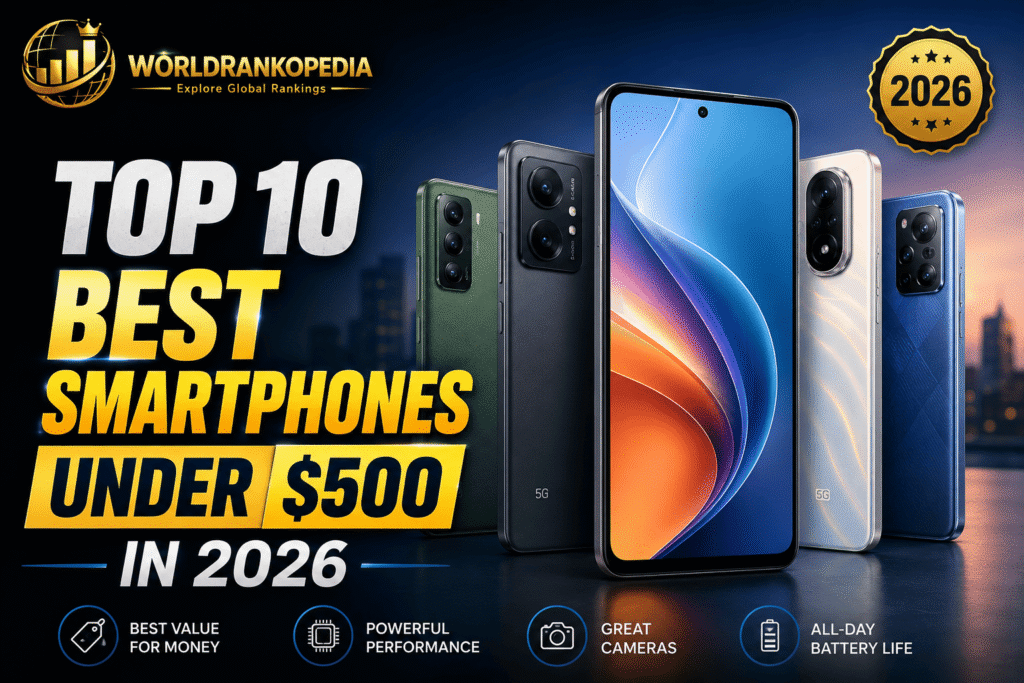
Here are the 10 best smartphones you can buy for under $500 in 2026, ranked, reviewed, and written for real people making real purchasing decisions.
1. Google Pixel 10a — Best Overall Pick (~$499)
If someone walked up to me on the street and said, “Just tell me the best phone under $500,” I’d say: Pixel 10a. Done.
Google’s latest A-series entry launched in March 2026 and immediately set the bar for what a mid-range phone can be. It runs on the Tensor G4 chip — the same silicon powering phones twice its price — and ships with Android 16 right out of the box. More importantly, Google promises 7 years of software and security updates, which means this phone will still be relevant in 2033. The 6.3-inch P-OLED display hits up to 3,000 nits peak brightness, making it perfectly readable in harsh sunlight. The camera system carries over the 48MP main sensor from the Pixel 9a, but Google’s computational photography magic continues to pull ahead of the hardware specs. Night shots, portrait mode, and the AI editing tools (like Magic Eraser and Photo Unblur) remain class leaders at this price.
One genuinely nice upgrade: the Pixel 10a finally bumps wired charging to 45W, fixing one of the bigger complaints about its predecessor. The camera module is now completely flat — a small aesthetic touch that means the phone actually lies flat on a table.
Key Specs:
- Display: 6.3-inch P-OLED, 120Hz, 3000 nits peak
- Processor: Google Tensor G4
- RAM/Storage: 8GB RAM, 128GB / 256GB
- Camera: 48MP main + 13MP ultrawide + 13MP selfie
- Battery: ~4,700mAh, 45W charging
- Software: Android 16, 7 years of updates
- Durability: IP68
Who should buy it: Anyone who wants the best camera and the longest software support in the sub-$500 category. This is the safe, smart, and thoroughly satisfying pick.
2. Samsung Galaxy A56 5G — Best for the Samsung Ecosystem (~$499)
Samsung has been refining the A-series for years, and the Galaxy A56 shows they haven’t run out of ideas yet. It launched internationally in early 2025 and finally made its US debut mid-year, arriving as one of the most feature-rich devices in its class. The 6.7-inch Super AMOLED display with 120Hz refresh rate is a visual treat — Samsung’s panel technology still produces some of the best colors and contrast ratios in the business. Protected by Gorilla Glass Victus+, the build quality feels more premium than the price suggests.
Under the hood, the Exynos 1580 chip handles everyday tasks — streaming, social media, photography, casual gaming — without breaking a sweat. You get a 5,000mAh battery with 45W fast charging, meaning a quick 30-minute top-up gives you plenty of juice to get through the day.
The triple camera setup (50MP main, 12MP ultrawide, 5MP macro) covers most shooting scenarios well. Photos are sharp in good light, though the macro lens is more of a checkbox feature than a genuine tool. The 12MP selfie camera is solid for video calls and social content. What really sets the A56 apart is the IP67 water resistance — a feature that’s rarer than it should be in this price range — and four years of OS updates backed by Samsung. If you’re deep in the Samsung ecosystem with a Galaxy Watch or Galaxy Buds, the A56 slots in naturally.
Key Specs:
- Display: 6.7-inch Super AMOLED, 120Hz, HDR10+
- Processor: Samsung Exynos 1580 (4nm)
- RAM/Storage: 8GB RAM, 128GB / 256GB
- Camera: 50MP + 12MP + 5MP rear, 12MP front
- Battery: 5,000mAh, 45W charging
- Durability: IP67
- Software: Android 15 (One UI 7), 4 years of OS updates
Who should buy it: Samsung loyalists, anyone wanting a large, beautiful display, and people who value water resistance in their daily carry.
3. OnePlus Nord 6 — Best for Performance (~$460)
OnePlus quietly launched one of the most impressive spec sheets in the mid-range category this year. The Nord 6 isn’t playing around — it packs the Snapdragon 8s Gen 4, a chipset that places it firmly in near-flagship performance territory. Benchmark scores bear this out: the Nord 6 handles demanding games, heavy multitasking, and sustained workloads in ways that $460 phones simply weren’t capable of a year ago.
But the headline feature — and yes, it’s genuinely wild — is the 9,000mAh battery. That’s not a typo. Combined with 80W fast charging, you’re looking at a phone that can comfortably power through two days of heavy use and still have room to share a charge with a friend via reverse wireless charging.
The 6.78-inch AMOLED display runs at a buttery 165Hz, which makes scrolling and gaming feel unnervingly smooth. The 50MP main camera produces detailed, punchy photos, and the 32MP selfie shooter is among the best in this price range. The trade-off? OxygenOS is excellent, but OnePlus’s long-term update commitment has historically been shorter than Google’s or Samsung’s. Still, for pure, tangible, day-to-day performance — and a battery that simply refuses to die — the Nord 6 is a force.
Key Specs:
- Display: 6.78-inch AMOLED, 165Hz
- Processor: Qualcomm Snapdragon 8s Gen 4
- RAM/Storage: 8GB / 12GB RAM, 256GB
- Camera: 50MP + additional sensors, 32MP selfie
- Battery: 9,000mAh (!), 80W charging
- Durability: IP68/IP69K + MIL-STD-810H
Who should buy it: Power users, gamers, and heavy travelers who need their phone to last — and then last some more.
4. Nothing Phone (4a) — Best Design & Clean Software (~$400)
Nothing has built a cult following by doing something the smartphone industry largely gave up on: making a phone that actually looks different. The Nothing Phone (4a) continues that tradition with its signature transparent back panel and the Glyph Interface — a programmable LED notification system on the rear that’s genuinely useful for silently checking calls, timers, and alerts without picking up the phone. But this isn’t just style over substance. The Phone (4a) runs on the Snapdragon 7s Gen 4 with 12GB of RAM, delivering smooth, stable daily performance. The 5,080–5,400mAh battery handles a full day comfortably, and 50W charging keeps downtime short.
Nothing OS remains one of the cleanest Android experiences available — no bloatware, no aggressive pre-installed apps, and a visual identity that feels distinctly human. Camera performance is solid for the price, with a 50MP OIS main camera doing respectable work in most lighting conditions. At around $400, it’s also the most wallet-friendly option on this list, which makes it an easy recommendation for anyone who wants a distinctive phone that doesn’t drain their bank account.
Key Specs:
- Display: 6.7-inch OLED, 120Hz
- Processor: Snapdragon 7s Gen 4
- RAM/Storage: 12GB RAM, 256GB
- Camera: 50MP OIS main, 50MP selfie
- Battery: ~5,200mAh, 50W charging
- Software: Nothing OS 3.0 (clean Android)
Who should buy it: Design-conscious buyers, Android purists, and anyone who wants to carry something that doesn’t look like every other phone in the room.
5. Motorola Edge 70 Fusion — Best Battery Life for the Price (~$350)
Motorola doesn’t always get the headlines it deserves. The Edge 70 Fusion is a genuinely well-rounded phone that quietly delivers on the things that matter most in everyday use: battery, display, and smooth performance.
The 5,000mAh+ battery combined with Motorola’s efficiency tuning means most users won’t need a midday top-up. The display is crisp and bright, the build feels solid without being heavy, and the camera produces reliable, natural-looking photos that are easy to share as-is. At $350 or less, the Edge 70 Fusion represents real value — a phone that does everything well without trying to be the flashiest option in the room. It’s the honest workhorse of this list.
Who should buy it: Budget-conscious buyers who want reliable all-day performance without any compromises that feel painful in daily use.
6. Realme 16 Pro — Best for Spec-Hunters (~$380)
The Realme 16 Pro is the kind of phone that makes you do a double-take at the spec sheet. For around $380, you’re getting a large-capacity battery (often above 5,500mAh), fast charging, a capable multi-camera system, and a high-refresh-rate OLED display.
Realme has matured a lot in the past couple of years. The software — Realme UI — is cleaner and less cluttered than it used to be, and performance on the MediaTek Dimensity chipset is impressively smooth for the price. The main camera handles everyday photography well, and there’s a satisfying crispness to shots in good light. The Realme 16 Pro won’t win any awards for long-term software support or ecosystem integration, but on raw specifications per dollar, it punches genuinely hard.
Who should buy it: Spec-driven buyers in markets where Realme is available, and anyone prioritizing hardware value above all else.
7. Motorola Moto G Power 2026 — Best Pure Battery Phone (~$300)
Some people just need their phone to last. Not two days — more like the entire week between Sunday charging sessions. For those people, the Moto G Power 2026 exists.
With an enormous battery capacity and Motorola’s notoriously efficient software, this phone is a marathon runner in a field full of sprinters. The performance is adequate rather than impressive — this isn’t a gaming phone or a camera powerhouse — but it handles messaging, navigation, social media, and calls without complaint. At around $300, the G Power also hits a price point that makes it accessible for first-time smartphone buyers, seniors, and anyone who wants a reliable backup device.
Who should buy it: Anyone whose primary frustration with their current phone is battery anxiety. This solves that problem completely.
8. Google Pixel 9a — Best Value After Price Drop (~$350–$399)
With the Pixel 10a now taking the spotlight, the Pixel 9a has quietly dropped into even better value territory. You’re getting the same Tensor G4 chip, the same excellent camera system, and the same 7-year software update promise — just at a price that’s now $100+ lower than it launched at.
The differences from the 10a are minor: slightly slower charging (18W wired vs 45W), a camera module that protrudes a hair more, and the original Pixel 9a’s display rather than the slightly brighter 10a panel. None of these is a dealbreaker. If you want Google’s AI features, Call Screen, on-device transcription, and the best camera processing in the sub-$400 space, the Pixel 9a at its current discounted price is arguably the single best value on this entire list.
Who should buy it: Smart shoppers who want Pixel quality without paying Pixel 10a prices.
9. Samsung Galaxy A36 5G — Best Budget Samsung (~$399)
A tier below the A56 but not a dramatic step down, the Galaxy A36 5G gives you a lot of what makes Samsung’s mid-range lineup compelling — the display quality, the camera reliability, the software polish — at a more approachable price.
The 6.6-inch Super AMOLED display at 120Hz is lovely, and Samsung’s One UI continues to be one of the better Android experiences for users transitioning from older Samsung devices. The camera is competent for everyday photography, and the battery handles a full day without drama. For anyone who’s been using an older Galaxy A-series phone and wants a clean upgrade without moving to a flagship, the A36 is an easy, risk-free recommendation.
Who should buy it: Galaxy upgrade seekers who don’t need the full A56 spec sheet and want to save $100.
10. iPhone 15 (Refurbished) — Best for iOS Users (~$400–$499)
Let’s address the Apple fan in the room. If you’re tied to the Apple ecosystem — AirPods, MacBook, iCloud, iMessage, FaceTime — buying an Android phone means more friction than it’s worth. The good news: a certified refurbished iPhone 15 can now be found for under $500, and it’s still a very capable phone.
The iPhone 15 brought a USB-C port (finally), the Dynamic Island, a 48MP main camera that shoots genuinely excellent photos, and the A16 Bionic chip — hardware that still handles everything iOS throws at it without hesitation. Apple’s software support track record is unmatched; these devices receive updates for six or more years consistently. Just make sure to buy from Apple Certified Refurbished or a reputable third-party seller. Avoid random marketplace listings with no warranty.
Who should buy it: Existing Apple ecosystem users who want to stay in iOS without spending $800+.
How to Choose the Right Phone for You
With ten solid options on the table, here’s a quick cheat sheet:
| You want… | Go with… |
|---|---|
| Best camera + longest updates | Google Pixel 10a |
| Samsung ecosystem + big screen | Galaxy A56 5G |
| Maximum performance | OnePlus Nord 6 |
| Unique design + clean Android | Nothing Phone (4a) |
| Best overall battery life | OnePlus Nord 6 or Moto G Power |
| Best value overall | Pixel 9a (discounted) |
| iOS / Apple ecosystem | iPhone 15 (refurbished) |
Final Thoughts
The under-$500 smartphone market in 2026 isn’t a compromise — it’s a genuine choice. The phones on this list don’t make you feel like you’ve settled. They make the $1,000+ phones feel like a bad deal. Our top recommendation remains the Google Pixel 10a for most buyers: it combines the best camera in its class, the strongest software support commitment, and a design that finally lies flat on a table. But honestly? You can’t go wrong with any of the ten options above.
Buy smart. Spend wisely. Enjoy your phone.