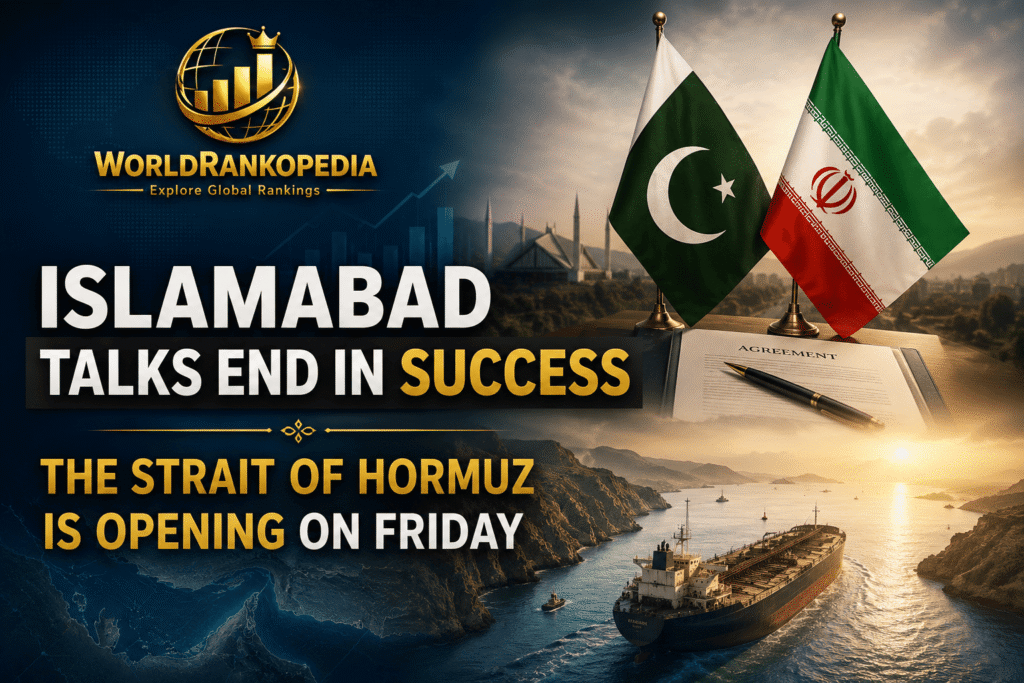
Islamabad Talks End in Success — The Strait of Hormuz Is Opening on Friday
Published on WorldRankOpedia.com | June 15, 2026
The world held its breath for months. Tankers sat idle. Oil prices surged. Entire economies trembled. And yet, through the quiet corridors of Pakistani diplomacy and exhausting rounds of back-channel negotiations, something remarkable finally happened — the United States and Iran have reached a deal. The Strait of Hormuz, that narrow but mighty chokepoint that carries roughly a fifth of the world’s oil and natural gas, is set to reopen on Friday.
This is not a small story. This might be one of the most consequential geopolitical breakthroughs of our generation.
From Crisis to Agreement: A Long Road Through Islamabad
Let’s rewind a little, because context matters here.
The conflict between the United States, Israel, and Iran erupted on February 28, 2026, when coordinated strikes were launched against Iranian targets. Almost immediately, Iran moved to exert control over the Strait of Hormuz — the narrow waterway sitting between the Persian Gulf and the Gulf of Oman. Tanker traffic collapsed by roughly 95%. The global energy market spiraled. Nations scrambled.
Pakistan stepped in as a neutral mediator, hosting the first formal round of talks at the Islamabad Serena Hotel on April 11 and 12, 2026. Those initial talks were grueling — 21 hours across three rounds — but they ended without a deal. The sticking points? Iran’s nuclear program and, critically, control of the Strait of Hormuz. Both sides walked away frustrated, and for a while, hope seemed distant.
But diplomacy rarely dies — it just takes detours.
In the weeks that followed, Pakistan’s army chief continued shuttling between Washington and Tehran, presenting proposals, testing red lines, building the fragile architecture that a real agreement would need. Slowly, painfully, the two sides inched closer together.
The Breakthrough Moment
This past weekend changed everything.
On Sunday, June 15, 2026, Pakistani Prime Minister Shehbaz Sharif broke the news that a peace deal between the United States and the Islamic Republic of Iran had been reached. In a post that reverberated around the world, he announced that both sides had declared an immediate and permanent end to military operations on all fronts, including Lebanon. He confirmed that mediators would facilitate a series of pre-implementation meetings this week, building the foundation for technical talks and, most importantly, the official signing ceremony.
That signing is scheduled to take place this Friday, June 19, in Geneva, Switzerland.
President Trump, never one to understate a moment, declared the deal complete on Truth Social and formally authorized the opening of the Strait of Hormuz to all international vessels. He called on ships from across the world to set sail and let commerce flow freely once again. He later clarified that the strait’s physical reopening would follow the formal signing on Friday, partly because mines laid during the conflict need to be cleared first.
Iran’s deputy foreign minister, Kazem Gharibabadi, confirmed the agreement but was clear that Tehran would not begin implementing its side of the deal until after the official signing. Iran wants guarantees — particularly the lifting of the U.S. naval blockade on Iranian ports and the release of billions in frozen Iranian assets — before it takes concrete steps. These conditions, Iran’s side insists, are the entry ticket into the 60-day formal negotiations that will follow.
What the Deal Actually Says
The agreement, which takes the form of a Memorandum of Understanding drafted using the Islamabad framework, is built around several key pillars.
First, there is a ceasefire — a 60-day cessation of military operations on all fronts. Second, the Strait of Hormuz will be reopened to all international commercial shipping without tolls or restrictions. Third, the United States has committed to ending its naval blockade of Iranian ports. Fourth, frozen Iranian financial assets — reportedly totaling tens of billions of dollars — will begin to be released.
Iran’s Mehr News Agency published what it described as the 14-clause MOU, and the terms, if accurately reported, represent significant concessions from Washington. Oil and petrochemical sanctions are reportedly suspended. Iran’s missile program and its relationships with regional proxy forces appear to have been carved out of the immediate negotiation agenda entirely, left for later rounds of talks. Iran has also reportedly sought a reconstruction commitment from Western nations for the damage sustained during the war.
Neither side released an official text of the MOU publicly, and several analysts have noted that the implementation details remain to be hammered out in the weeks ahead.
What This Means for the World
Friday’s opening of the Strait of Hormuz will not flip a switch on global energy markets overnight. Experts are clear-eyed about this — it will likely take months for oil and gas shipments to normalize, for shipping lanes to be certified as safe, and for the price shockwaves to gradually calm. Mines in the strait must be cleared. Vessels that have been rerouted around Africa at enormous cost need time to adjust their logistics.
But the symbolic weight of Friday cannot be overstated.
Before the war, about one in five barrels of oil consumed globally passed through this narrow strip of water. The closure triggered one of the most severe energy crises in recent memory. Fuel prices spiked. Supply chains buckled. Developing nations — many of whom had no hand in the conflict — bore some of the highest costs. The reopening of the strait is not just good news for oil traders; it is good news for every family paying inflated energy bills, every business struggling with transport costs, and every economy that was collateral damage in this conflict.
The world’s reaction has been swift and warm. British Prime Minister Keir Starmer called the deal a hugely important step toward regional stability and signaled that the UK stands ready to support the technical talks ahead. France’s President Macron noted that French naval assets, including the aircraft carrier Charles de Gaulle, were already positioned in the area and could contribute to a multilateral maritime security mission if needed. Leaders from across the globe have echoed similar sentiments — cautious optimism, but optimism nonetheless.
Pakistan’s Quiet But Enormous Role
It is impossible to write about this deal without pausing to acknowledge Pakistan’s role.
In a moment where traditional diplomatic channels between Washington and Tehran were essentially broken, Islamabad became the bridge. Pakistan’s Prime Minister and army chief worked tirelessly behind the scenes — hosting talks, presenting proposals, carrying messages, absorbing frustrations from both sides, and keeping the conversation alive even when it seemed dead.
The “Islamabad Memorandum of Understanding” is not just a name. It is a testament to what middle-power diplomacy can accomplish when great powers cannot talk to each other directly. Pakistan did not stand to gain oil revenues or military contracts from this deal. It stepped in because regional stability matters — and because sometimes, the most important role in a room is simply making sure everyone stays in it.
Caution Remains the Word of the Day
It would be naive to call this a done deal in every sense of the phrase. Luxembourg’s Foreign Minister Xavier Bettel captured the mood perfectly when he noted that it is a long road to Friday.
Iran has made clear that implementation is conditional on the United States meeting its commitments first — particularly around financial assets and the naval blockade. Netanyahu’s government in Israel has signaled that Israel does not necessarily consider itself bound by the Lebanon provisions of the agreement, raising questions about whether the ceasefire on that front will hold. And within Iran itself, footage from Tehran showed protesters near the Islamic Revolution Square waving flags and pushing back against the deal.
The 60-day negotiation period that follows the signing will be even harder than what got the world to this point. Deeper structural issues — Iran’s nuclear program, long-term sanctions architecture, regional security arrangements — remain entirely unresolved. The MOU is a beginning, not an ending.
A Moment Worth Recognizing
But let’s not lose the forest for the trees.
After more than three months of war, a fragile and frequently-broken ceasefire, dramatic military exchanges, and an energy crisis that rattled the global economy, two adversaries have agreed — in writing, through a neutral mediator — to stop fighting and open the world’s most important oil shipping lane.
Ships are preparing to sail. Tankers that have been sitting idle are calculating new routes. Energy traders are recalibrating. And on Friday, in Geneva, representatives of two nations that have been at war will sit down together to sign a piece of paper that says: enough.
History does not always move in clean arcs. Peace deals get broken. Ceasefires collapse. Negotiations fail. But sometimes — sometimes — the world gets a moment where it pulls back from the edge. This might be one of those moments.
Stay tuned to WorldRankOpedia.com as we continue to follow developments through the signing ceremony and beyond.
All content on WorldRankOpedia.com is independently written and fact-checked.