World Leaders by Age 2026
Full List of Global Leaders Ranked by Age.
Discover the ages of current world leaders in 2026. Explore a detailed comparison of global political figures, from the oldest to the youngest leaders shaping the world today. World leaders by age world-leaders-by-age-2026 In global politics, leadership is shaped not only by ideology and policy but also by age and experience. The current lineup of world leaders reflects a fascinating mix of seasoned veterans and younger reformers. From leaders in their late 70s to those in their 40s, this diversity highlights how different nations approach governance. In this article, we explore the ages of major world leaders in 2026, analyse trends, and understand what this means for the future of global politics. Oldest World Leaders in 2026. At the top of the age spectrum, we find leaders who bring decades of political experience:
1
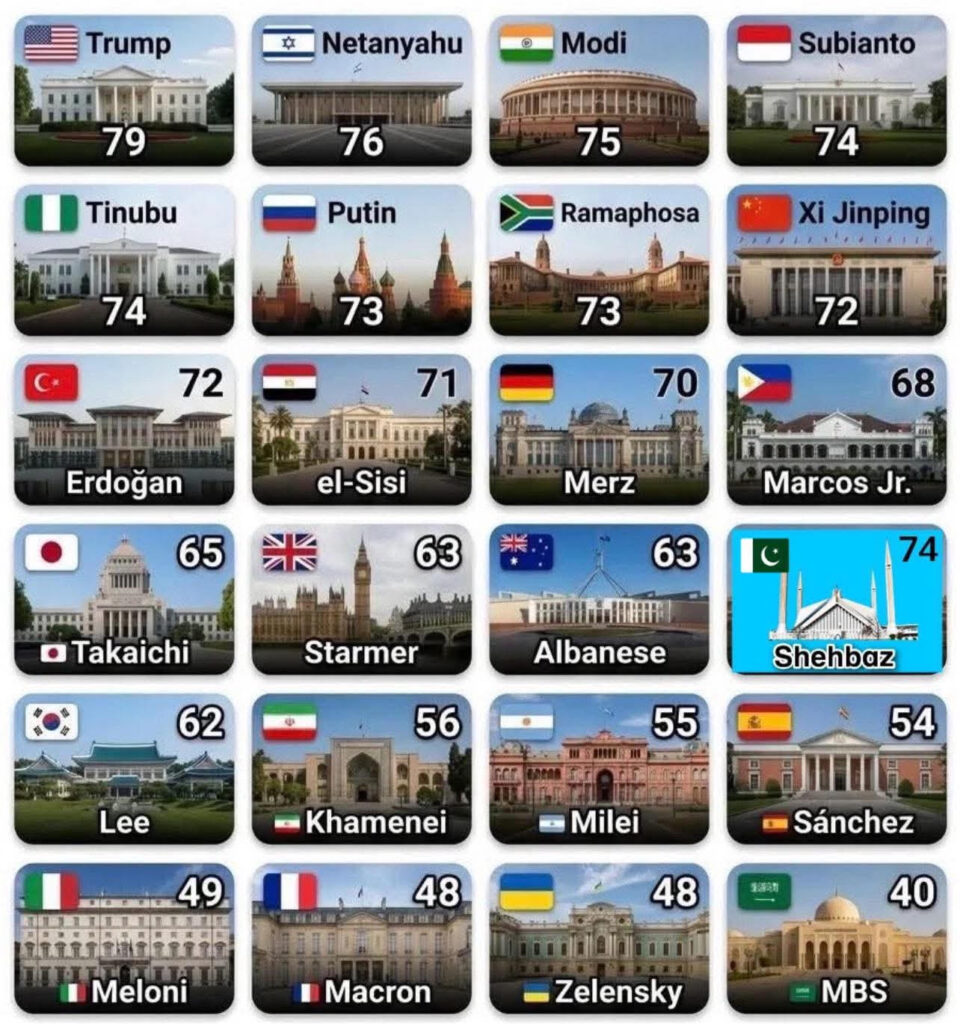
Donald Trump 79 years Old
2
Benjamin Netanyahu 76 years Old
3
Narendra Modi 75 years Old
These leaders have long political careers and are known for their strong influence on national and international affairs. Their experience often translates into strategic decision-making and established diplomatic relationships.
Leaders in Their 70s: Dominating Global Politics. A large number of world leaders fall into the 70–74 age group:
4
Prabowo Subianto 74 years Old
5
Bola Ahmed Tinubu 74 years Old
6
Shehbaz Sharif 74 years Old
7
Vladimir Putin 73 years Old
8
Cyril Ramaphosa 73 years Old
9
Xi Jinping 72 years Old
10
Recep Tayyip Erdoğan 72 years Old
This group represents the core of global leadership, controlling some of the world’s largest economies and most influential political systems.
Leaders in Their Late 60s to Early 70s
These leaders often act as a bridge between traditional and modern governance:
11
Abdel Fattah el-Sisi 71 years Old
12
Friedrich Merz 70 years Old
13
Ferdinand Marcos Jr. 68 years Old
They are typically focused on economic reforms, national stability, and global cooperation.
Mid-60s Leaders: Modern Political Thinkers
14
Sanae Takaichi 65 years Old
15
Keir Starmer 63 years Old
16
Anthony Albanese 63 years Old
This age group often demonstrates balanced leadership, combining experience with adaptability to modern challenges like climate change and digital transformation.
Leaders in Their 50s and Early 60s
17
Yoon Suk Yeol 62 years Old
18
Ali Khamenei 56 years Old
19
Javier Milei 55 years Old
20
Pedro Sánchez 54 years Old
These leaders are often seen as policy-driven and reform-focused, bringing new ideas into governance. Youngest World Leaders in 2026: A new generation of leadership is emerging: Giorgia Meloni 49 years Old
21
Emmanuel Macron 48 years Old
22
Volodymyr Zelenskyy 48 years Old
23
Mohammed bin Salman 40 years Old
These leaders are known for their energy, innovation, and strong media presence, often connecting more effectively with younger audiences.
Key Insights: What Leadership Age Reveals
1. Experience Still Matters Most. Global leaders are above 60, showing that political experience remains highly valued.
2. Slow Generational Shift: While older leaders dominate, younger leaders are steadily rising, indicating a gradual shift in global leadership trends.
3. Regional Differences Western countries are increasingly electing younger leaders. Asian and Middle Eastern regions still favour experienced leadership
4. Age vs Effectiveness: Age does not define success. Leadership effectiveness depends on vision, policy execution, and public support, not just years. Why This Matters for the Future: Understanding the ages of world leaders helps us predict: Policy directions
Global alliances
Economic strategies; technological adoption. As younger leaders gain influence, we may see faster innovation and policy changes, while older leaders may continue to provide stability and long-term vision.
Final Verdict
The global political stage in 2026 reflects a blend of experience and new energy. From seasoned figures like Donald Trump to younger leaders like Mohammed bin Salman, the diversity in age highlights how different nations choose their leaders.
As the world evolves, the balance between experience and innovation will shape the future of global governance.