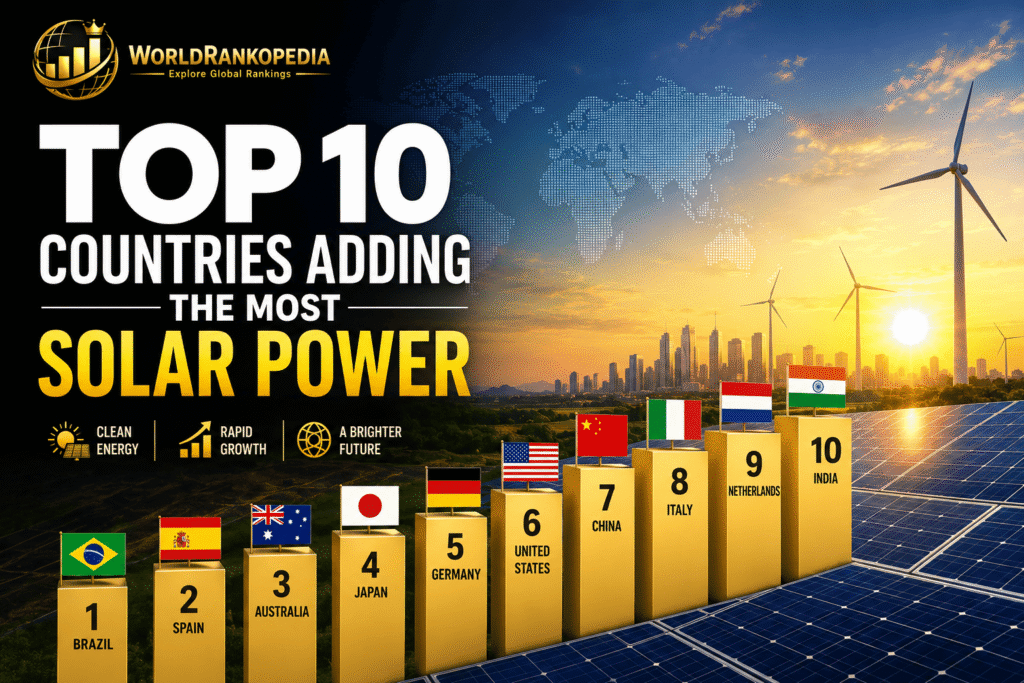
Top 10 Countries Adding the Most Solar Power in 2026
Published on WorldRankopedia.com | Energy & Environment
There’s something quietly extraordinary happening on rooftops, deserts, and floating reservoirs across the globe. Country by country, solar panels are going up at a pace that would have seemed science fiction just a decade ago. In 2024 alone, the world added nearly 600 gigawatts of solar capacity — a single-year record — pushing the total past 2.2 terawatts globally. To put that in perspective, the entire global solar fleet only crossed 1 terawatt in 2022. It doubled in less than two years.
So which countries are actually driving this revolution? At WorldRankOpedia, we dug into the latest data to rank the top 10 nations adding the most solar power, and the results reveal some fascinating stories about ambition, geography, policy, and pure competitive drive.
1. China 🇨🇳 — The Solar Superpower
No list about solar energy starts anywhere but here. China doesn’t just lead — it dominates in a category of its own. By the end of 2024, the country had installed roughly 888 gigawatts of solar capacity, five times that of its nearest competitor. In a single year, China added over 278,000 MW of new solar — more than most countries have accumulated in total.
What’s driving this? A mix of government-backed renewable mandates, unmatched manufacturing scale, and ultra-low-cost panel production. China had already surpassed its 2030 renewable energy targets years ahead of schedule, and it’s still accelerating. The country’s Renewable Energy Law and massive public investment have created a solar ecosystem unlike anything else on Earth. Love it or not, China is rewriting what’s possible in clean energy.
2. United States 🇺🇸 — Policy Meets Scale
The U.S. sits firmly in second place, with 177,470 MW of installed solar capacity as of 2024 — and it’s growing fast. In that year alone, solar accounted for more than half of all new electricity capacity added in the country. States like California, Texas, and Florida are leading the charge, with both massive utility-scale solar farms and booming residential rooftop adoption.
The Inflation Reduction Act has been a genuine game-changer, offering a 30% tax credit for solar installations extended through 2035. The target? 377 GW of solar capacity by 2028. The U.S. story is one of policy momentum meeting geographic advantage — and right now, both are pointing in the right direction.
3. India 🇮🇳 — The World’s Fastest-Growing Solar Market
India is the one to watch. With roughly 119 GW of capacity as of mid-2025 and a blistering annual growth rate, India has officially overtaken Japan to become the world’s third-largest solar market. The country gets around 300 sunny days per year across most of its territory, giving it a natural edge that few nations can match.
India’s solar power is also among the cheapest in the world — touching $0.03 per kilowatt-hour in some auctions. States like Rajasthan, Gujarat, and Karnataka are home to sprawling solar parks, while rooftop systems are rapidly spreading through cities and towns. India’s goal of 500 GW of renewable capacity by 2030 is ambitious, but the trajectory suggests it’s achievable.
4. Germany 🇩🇪 — Europe’s Solar Pioneer
Germany shouldn’t be this good at solar. It’s not especially sunny. Yet it has nearly 90 GW of installed capacity and a clear roadmap to 215 GW by 2030. That says everything about the power of long-term policy commitment.
Germany pioneered the feed-in tariff model that seeded solar growth across Europe, and its Energiewende (energy transition) policy framework remains one of the world’s most comprehensive. Today, solar contributes more than 14% of Germany’s national electricity generation. Rooftop installations are embedded in everyday life — on homes, barns, and industrial buildings alike. Germany shows that solar isn’t just for sun-soaked places; it’s for nations that decide to make it happen.
5. Japan 🇯🇵 — Innovation Over Expansion
Japan’s solar journey began in earnest after the Fukushima disaster in 2011 prompted a hard rethink of its energy mix. With limited land and a dense population, Japan turned to innovation: floating solar arrays on reservoirs, building-integrated photovoltaics, and high-efficiency rooftop systems. The country holds around 89 GW in total capacity.
Growth has slowed in recent years — just 2.8% year-over-year — as the easy sites fill up and grid integration becomes trickier. But Japan’s contribution to solar technology, particularly in high-efficiency perovskite cells, keeps it essential to the global story.
6. Brazil 🇧🇷 — The Southern Hemisphere Surge
Brazil added 17.3 terawatt-hours of solar generation in 2025, one of the highest single-year jumps in the world. With an enormous landmass, high solar irradiance across the northeast, and a government keen to diversify beyond hydropower, Brazil has become Latin America’s undisputed solar leader.
Large utility-scale projects are multiplying across states such as Bahia and Piauí, while small commercial and residential installations are accelerating. Brazil’s solar future looks very bright — literally.
7. Australia 🇦🇺 — The Rooftop Nation
Australia has one of the world’s highest rates of household solar adoption — nearly one in three homes now has panels on the roof. With over 38 GW of installed capacity and 15.6% annual growth, Australia punches well above its weight, given its relatively small population.
Intense sunlight, falling costs, and strong community buy-in have made solar almost a cultural norm in parts of the country. Large-scale projects are also accelerating, meaning Australia’s trajectory is far from flat.
8. Spain 🇪🇸 — Southern Europe’s Solar Comeback
Spain’s solar story stalled for years after regulatory uncertainty drove investors away in the 2010s. But the country has made a confident return, reaching 38.5 GW of installed capacity with nearly 21% growth year-over-year. Favorable sunshine, large open land, and renewed policy support have made Spain one of Europe’s most exciting solar markets again.
9. Türkiye 🇹🇷 — Explosive Growth
Among the top 15 countries globally, Türkiye posted the most dramatic relative growth in 2024 — a stunning 76.1% increase year-over-year, bringing it to nearly 25 GW. Solar suits Turkey’s climate naturally, especially in its Mediterranean and southeastern regions. The economics are compelling too: every gigawatt of solar installed reduces costly gas import bills significantly. Expect Türkiye to keep climbing these rankings.
10. Pakistan 🇵🇰 — The Rising Wildcard
Pakistan may surprise some readers here, but the numbers don’t lie. In 2025, it recorded one of the top five gains in solar generation globally, adding 16.8 terawatt-hours — just behind Brazil. With frequent power shortages pushing households and businesses toward off-grid and on-grid solar solutions, Pakistan has seen a grassroots solar revolution, particularly in rooftop adoption. Policy is still catching up with market reality, but the momentum is real and growing.
The Bigger Picture
What these ten countries share — despite their very different sizes, climates, and economies — is a commitment to treating solar not as a future technology but as a present-day solution. Solar panel costs have fallen 90% since 2015, making the economics undeniable. The question for most nations is no longer can we afford solar? — it’s can we afford not to?
The race is on, and it’s one where everyone can win.
© WorldRankopedia.com — www.worldrankopedia.com