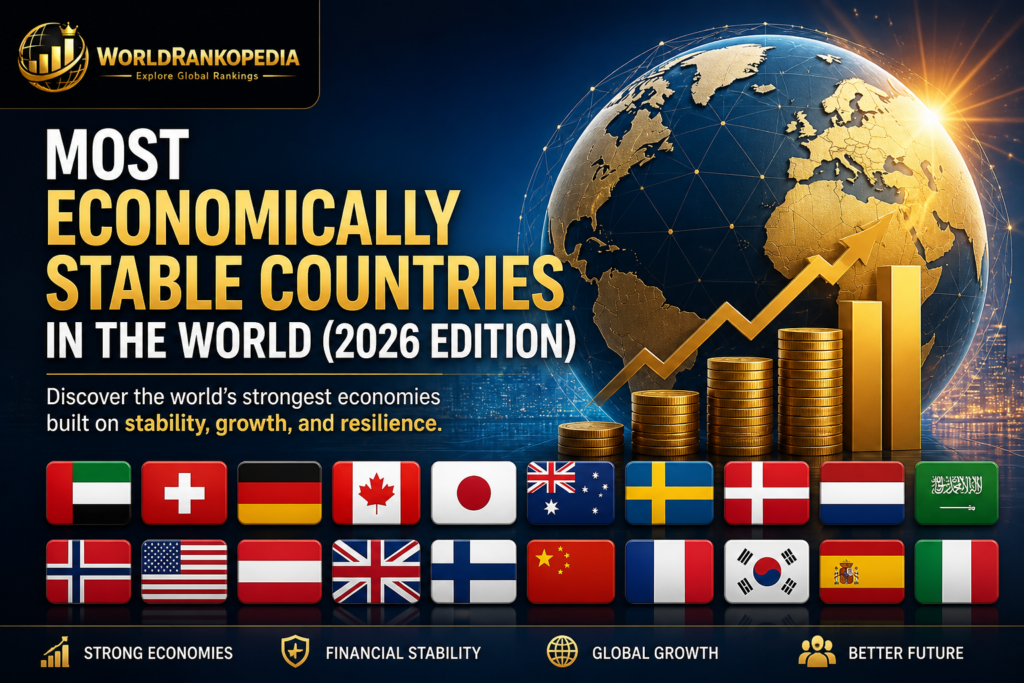
Economic stability is one of the most important indicators of a nation’s strength and long-term prosperity. It reflects how well a country can maintain steady growth, control inflation, provide employment, and sustain a high quality of life for its citizens. In today’s interconnected world, stable economies not only benefit their own populations but also play a critical role in global financial balance.
In this article, we explore some of the most economically stable countries in the world, based on factors such as GDP growth, inflation control, political stability, currency strength, and overall economic resilience.
What Defines Economic Stability?
Before diving into the rankings, it’s important to understand what makes an economy stable:
Low and controlled inflation
Strong and diversified industries
Stable political environment
Healthy banking and financial systems
Consistent GDP growth
Countries that perform well in these areas are generally considered economically stable and reliable for investment, business, and living standards.Top 10 Most Economically Stable Countries
United Arab Emirates (UAE)
The United Arab Emirates has transformed from an oil-based economy into a diversified powerhouse. With strong sectors like tourism, real estate, and finance, along with tax-friendly policies, the UAE continues to attract global investors.
2,
Switzerland
Switzerland is globally known for its banking system, political neutrality, and high-income economy. Its strong currency and financial discipline make it one of the safest economies worldwide.
3,
Germany
As Europe’s largest economy, Germany thrives on manufacturing, exports, and industrial innovation. German cars also have strong fan followings worldwide. Its robust economic structure ensures long-term stability.
4,
Canada
Canada offers a balanced economy supported by natural resources, technology, and services. It also benefits from strong governance and a stable banking system.
5,
Japan
Japan is a global leader in technology and manufacturing. Despite challenges like an ageing population, its economic discipline keeps it stable.
6,
Australia
Australia enjoys consistent growth due to the mining, education, and tourism sectors. Its economic resilience has helped it avoid major recessions. Australian currency is the Australian Dollar
7,
Sweden
Sweden combines innovation with social welfare, creating a strong and inclusive economy.
8,
Denmark
Denmark is known for its efficient government, low corruption, and high living standards, making its economy highly stable.
9,
Netherlands
The Netherlands has a strong trade-based economy supported by logistics, agriculture, and finance.
10,
Saudi Arabia
Saudi Arabia is diversifying rapidly through Vision 2030, reducing reliance on oil and strengthening economic sustainability. Saudi Arabia’s currency name is the Riyaal
Other Economically Stable Nations
11,
Norway
Norway benefits from oil wealth and a massive sovereign fund, ensuring long-term economic security.
12,
United States of America
The United States remains the world’s largest economy, driven by innovation, technology, and global influence.
13,
Austria
Austria enjoys a strong industrial base and stable financial institutions.
14,
United Kingdom (England, Scotland, Wales, and Northern Ireland)
The United Kingdom continues to be a global financial hub despite economic uncertainties.
15,
Finland
Finland is known for innovation, education, and economic transparency.
16,
China
China is a global manufacturing giant with significant influence on international trade.
17,
France
France maintains a diverse economy supported by tourism, agriculture, and industry. The Eiffel Tower is a famous tourist attraction in Paris, France
South Korea
South Korea excels in technology and exports, with companies dominating global markets. South Korea’s capital is Seoul.
19,
Spain
Spain has recovered strongly from past crises, supported by tourism and services.
20,
Italy
Italy remains a key European economy with strong manufacturing and cultural industries.
Emerging and Developing Stable Economies
While not at the very top, these countries are improving their economic stability:
21,
Russia – Resource-rich economy with geopolitical challenges
22,
Czechia – Growing industrial and export economy
23,
Hungary – Expanding manufacturing sector
24,
Türkiye – Strategic location with growing trade influence
25,
Slovenia – Stable small European economy
Fast-Growing but Volatile Economies
These nations show strong growth potential but face challenges to stability:
26,
India – Rapid growth with structural challenges
27,
Brazil – Large economy with political and inflation risks
28,
Egypt – Strategic economy with reform efforts
29,
Mexico – Strong trade links but economic fluctuations
30,
Argentina – High inflation impacts stability
31,
South Africa – Resource-rich but facing internal challenges
Economies Facing Stability Challenges
These countries are working toward economic recovery:
32,
Iran – Sanctions impacting growth
33,
Kazakhstan – Resource-dependent economy
34,
Bangladesh – Growing but with infrastructure challenges
25,
Kenya – Emerging economy with debt concerns
36,
Ukraine – Economic disruption due to conflict
Highlighted Insights
Diversification is key – Countries that rely on multiple industries are more stable
Strong institutions matter – Governance plays a major role in economic success
Global integration helps – Trade and international partnerships boost resilience
Innovation drives growth – Technology-based economies tend to be more stable
Moral
Economic stability is not just about wealth—it’s about consistency, resilience, and future readiness. While developed nations dominate the top positions, many emerging economies are rapidly improving and could reshape global rankings in the coming years.
For investors, travellers, and policymakers, understanding these trends is essential for making informed decisions in an ever-changing global landscape.