The City That Stitched the World’s Dreams: Sialkot and the FIFA World Cup Ball
Every four years, billions of eyes lock onto a single object hurtling through the air — a football. Not the stadiums, not the trophies, not even the players for that one suspended moment. Just the ball. But have you ever stopped mid-celebration to wonder: where was that ball actually made?
The answer, more often than not, leads to a city in Pakistan that most casual football fans couldn’t point to on a map — yet it has quietly shaped the most-watched sporting event in human history.
A Small City With a Giant Footprint
Sialkot sits in the Punjab province of Pakistan, roughly 125 kilometers from Lahore. It isn’t glamorous in the way that World Cup host cities are. There are no giant stadiums, no roaring crowds, no floodlit pitches. What it does have is generations of craftspeople, tightly knit workshops, and an almost obsessive mastery of one craft: making footballs.
And for the last 10 FIFA World Cups — from Italy 1990 all the way to the upcoming 2026 tournament — Sialkot has manufactured the official match ball for eight out of ten editions. That’s not a coincidence. That’s a legacy.
Walking Through the Decades, One Ball at a Time
1990 — Italia: The Etrusco Unico
The tournament that gave us Schillaci, Milla, and Gazza’s tears also gave us the Etrusco Unico — a black-and-white ball adorned with Etruscan warrior heads. Elegant, classic, unmistakably Italian in spirit. But the hands that assembled it? Pakistani. Sialkot workers stitched together the ball that Diego Maradona’s Argentina chased all the way to the final.
1994 — USA: The Adidas Questra
America got its first taste of the World Cup in 1994, and the ball — the Adidas Questra — was engineered to fly faster and farther than anything before it. It was built for the heat, the wide-open pitches, and the theatrical style of American presentation. Sialkot delivered, quietly and efficiently, as it always does.
1998 — France: The Adidas Tricolore
France 98 was a coming-of-age tournament in every sense. Zidane rose. Ronaldo faltered. And the Adidas Tricolore — the first World Cup ball to feature color — became iconic. Blue, red, and gold against white. Tricolore by name, tricolore by nature. And once again, born in Sialkot.
2002 — Korea/Japan: The Adidas Fevernova
This one turned heads. The Fevernova ditched the classic black-and-white for a striking gold-and-silver design with swirling patterns inspired by East Asian art. It was polarizing — some loved it, some thought it looked like a toy — but few knew it was another Sialkot creation. By now, the city had become indispensable.
2006 — Germany: The Adidas Teamgeist
Here’s where the story takes its first detour. The Teamgeist was manufactured in Thailand, breaking Sialkot’s uninterrupted streak. It was also the ball that sparked one of football’s most enduring debates — its near-perfect sphere made it swing unpredictably in the air, driving goalkeepers to despair. Germany 2006 was a tournament of beautiful football, and the Teamgeist played its part — just not from Pakistani soil.
2010 — South Africa: The Adidas Jabulani
South Africa brought the vuvuzelas, the drama, and the Jabulani — arguably the most controversial World Cup ball ever made. Its knuckleball behavior at high speeds left goalkeepers looking helpless and sparked worldwide debate. Manufactured in China, it remains the most talked-about ball in recent memory, for better or worse. Casillas, Buffon, and Neuer all complained. The ball didn’t care.
2014 — Brazil: The Adidas Brazuca
After two consecutive tournaments away from Sialkot, the ball came home. The Brazuca — named by Brazilian fans themselves in a public vote — was built to correct everything the Jabulani got wrong. More predictable, more responsive, and more beautiful. Brazil 2014 gave us some of the most stunning goals in recent World Cup history, and the Brazuca was right there for all of them. Sialkot was back.
2018 — Russia: The Adidas Telstar 18
Named in tribute to the original 1970 World Cup ball, the Telstar 18 blended nostalgia with modern technology. It featured a pixelated black-and-white design that paid homage to the classic hexagonal pattern, alongside an embedded NFC chip — the first World Cup ball you could interact with using your smartphone. A nod to the past, a leap into the future. Made in Sialkot.
2022 — Qatar: The Adidas Al Rihla
Al Rihla — Arabic for “the journey” — was the perfect name for a ball used in a World Cup that was itself an unprecedented journey. The first tournament held in the Arab world, the first in winter, and the one that gave us the greatest World Cup final in history. The Al Rihla was also notable for being the fastest World Cup ball ever tested. And it was made in Sialkot, with sustainable materials no less — a symbol of a city evolving with the times.
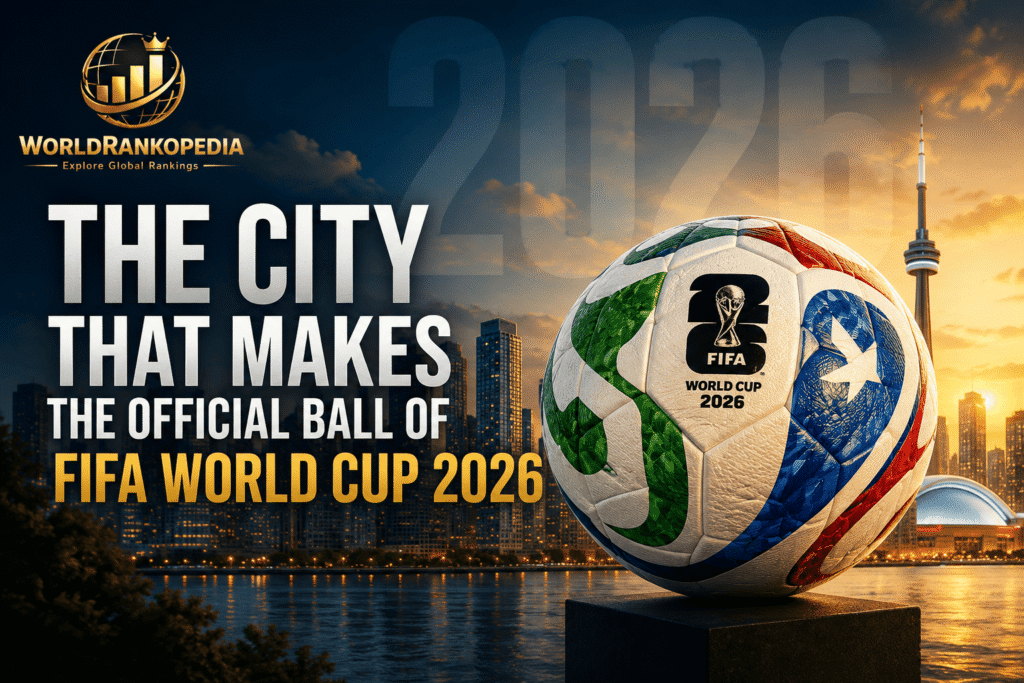
2026 — USA/Canada/Mexico: The Adidas Trionda
The upcoming 2026 World Cup — the largest in history with 48 teams — will be played with the Adidas Trionda. Its name reflects the three host nations. Its design is vibrant, bold, and modern. And its manufacturing location? Sialkot, Pakistan. The city that started this journey in 1990 will carry it forward into a new era.
Why Sialkot? The Real Story Behind the Numbers
It’s tempting to treat Sialkot’s dominance as just a manufacturing statistic. But there’s something deeper going on.
Football production arrived in Sialkot in the early 20th century, initially through British colonial trade. Over decades, local craftsmen didn’t just learn the skill — they mastered it. By the 1980s and 90s, Sialkot had become the world’s largest producer of hand-stitched footballs, accounting for an estimated 70–80% of global production at its peak.
The FIFA stamp of approval wasn’t handed to Sialkot on a platter. The city had to meet rigorous quality standards, navigate international labor rights scrutiny in the 1990s, and continuously upgrade its technology. It did all of that — and kept making World Cup balls.
There’s a quiet pride in Sialkot that the world rarely acknowledges. The workers in those workshops don’t watch the World Cup from VIP boxes. But they know, with every stitch, that their hands built the thing that billions are watching.
Two Exceptions That Prove the Rule
Thailand (2006) and China (2010) each hosted production for one World Cup ball apiece. Both times, controversy followed — the Teamgeist’s flight behavior and the Jabulani’s unpredictability became talking points that overshadowed the games themselves. Whether that’s coincidence or correlation is up for debate. But the fact that Adidas returned to Sialkot from 2014 onwards and never left again says something.
More Than Just a Ball
The FIFA World Cup ball is not just sports equipment. It is a cultural artifact. It carries the fingerprints — literally — of the tournament it represents. The Tricolore captured French elegance. The Brazuca embodied Brazilian flair. The Al Rihla told a story of journeys across continents.
And behind nearly all of them, quietly and consistently, is a city in Pakistan doing what it does better than anywhere else on earth. Next time you watch a World Cup match and see that ball arc into the top corner, take a moment. Somewhere in Sialkot, someone stitched that dream into existence.
For more deep dives into the stories behind world football, sports rankings, and global sports culture, explore WorldRankopedia.com.