Have you ever sat there watching that little loading circle spin while your video buffers — and thought, “somewhere in the world, someone is streaming this in 4K without a single hiccup”? Well, you’re right. And that “somewhere” is usually a short list of countries that have gone all-in on digital infrastructure.
In 2025, internet speed is no longer just a convenience — it’s the backbone of economies, healthcare systems, remote work culture, and education. The gap between the fastest and slowest connected nations is staggering, and the countries at the top didn’t get there by accident. They invested, planned, and prioritized connectivity like a national superpower.
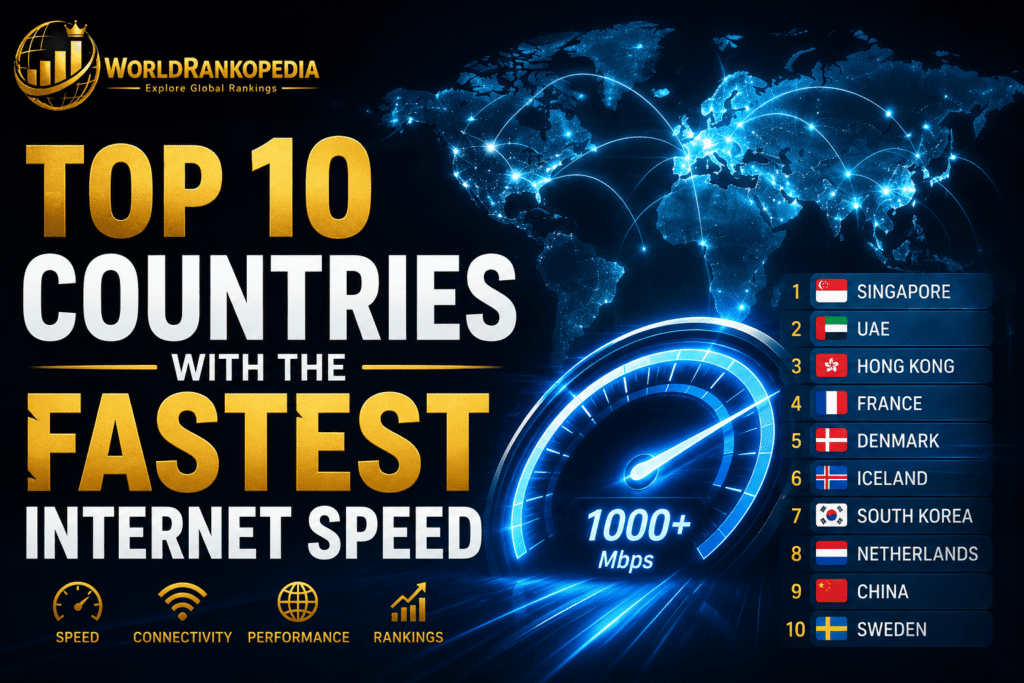
Let’s take a deep dive into the top 10 countries with the fastest internet speeds in the world — and more importantly, why they’re winning the connectivity race.
Why Internet Speed Matters More Than Ever
Before we get into the rankings, it’s worth asking: why does this matter so much?
Think about what runs on fast internet today — telemedicine, autonomous vehicles, AI-driven services, cloud gaming, 4K video calls, remote surgery, and smart city infrastructure. The countries that have built ultra-fast networks aren’t just giving their citizens quicker Netflix streams. They’re building the digital highways that their entire future economies will travel on.
Speed rankings in this article are based on fixed broadband download speeds measured by the Speedtest Global Index (Ookla) and Cable.co.uk’s Worldwide Broadband Speed League, using data aggregated from over a billion speed tests conducted worldwide in 2025.
🥇 1. Singapore — The Gold Standard (~345–410 Mbps)
If internet speed were an Olympic sport, Singapore would be standing on the podium every single year. This tiny city-state of just over 5 million people has turned fast connectivity into a national identity.
Singapore’s secret? It’s not just money — it’s strategy. The country built its Next Generation Nationwide Broadband Network (NGNBN) from scratch, creating a fiber-optic backbone that now covers virtually every household in the country with access to speeds up to 1 Gbps. The government, through the Infocomm Media Development Authority (IMDA), has also committed an additional S$100 million to upgrade the network to 10 Gbps by 2028 — speeds most of the world can barely imagine.
Average fixed broadband speeds hover between 345 and 410 Mbps, depending on the measurement period. To put that into perspective, downloading a full HD movie takes roughly 20–25 seconds.
What makes Singapore’s model remarkable isn’t just the speed — it’s the equity. Whether you live in a luxury high-rise in Marina Bay or a public housing block in Tampines, you get essentially the same blazing connection. That kind of universal access is something even richer nations struggle to achieve.
Fun Fact: Singapore is also home to some of Asia’s most competitive internet pricing, partly because multiple ISPs compete on the same open-access infrastructure — driving quality up and costs down.
🥈 2. France — Europe’s Quiet Overachiever (~315 Mbps)
France doesn’t always get credit in tech conversations, but its internet infrastructure quietly ranks among the best on the planet. Powered by the national Plan France Très Haut Débit (Very High-Speed France Plan), the country has aggressively rolled out fiber-optic connections across both urban centers and — crucially — rural areas that many nations overlook.
With average fixed broadband speeds around 315 Mbps, France has leapfrogged many expected contenders to sit comfortably in the global top three. The French approach is notable because it doesn’t just reward cities. Rural communes that once struggled with dial-up-era speeds are now getting gigabit-capable fiber connections — a testament to a policy that treats connectivity as a public right, not a premium product.
France’s rise also reflects fierce competition among telecom operators like Orange, SFR, Bouygues, and Free, which have effectively raced each other to offer better plans at lower prices.
🥉 3. United Arab Emirates — Speed Meets Ambition (~313 Mbps Fixed | 540+ Mbps Mobile)
The UAE is a fascinating case study in what happens when a nation decides to build the future on purpose. With an average fixed broadband speed of around 313 Mbps, it’s already in the global top three — but where the UAE truly dominates is mobile internet, where it leads the world with speeds exceeding 540 Mbps in some measurements.
This mobile dominance isn’t accidental. The UAE’s Smart Dubai initiative and similar smart city projects across Abu Dhabi require ultra-low latency and massive bandwidth for IoT sensors, autonomous transit systems, and cloud-connected urban infrastructure. The investment in 5G and fiber has been a strategic move, not just a telecom upgrade.
Strong competition between providers like Etisalat (e&) and du — combined with government backing — has created a connectivity environment that rival nations are studying and trying to replicate.
For travelers and digital nomads, the UAE is increasingly becoming one of the most plug-and-play connected destinations in the world.
4. Hong Kong — Dense, Fast, and Remarkably Reliable (~310 Mbps)
Hong Kong’s internet story is, in many ways, a story of geography working in its favor. As one of the most densely populated places on Earth, laying fiber-optic cable becomes dramatically more efficient — you cover millions of people without having to span vast empty distances.
With average fixed broadband speeds around 310 Mbps, Hong Kong maintains its position as Asia’s connectivity hub, powering one of the world’s leading financial centers and a massive e-commerce ecosystem. The city’s competitive telecom market — with multiple ISPs aggressively undercutting each other — means consumers get excellent speeds at relatively affordable prices.
For businesses, Hong Kong’s connectivity isn’t just fast — it’s dependable. Finance, media, and logistics firms that rely on real-time data flows count on that reliability as much as the speed itself.
5. Chile — Latin America’s Speed Champion (~297 Mbps)
Chile’s appearance in the global top 10 surprises many people, but it absolutely deserves its spot. As the most digitally advanced nation in Latin America, Chile has outpaced far wealthier countries through a combination of smart policy and determined infrastructure investment.
The Fibra Óptica Nacional (FON) program — Chile’s national fiber project — has expanded broadband access to regions that previously had little to no high-speed connectivity. Liberalized spectrum auctions and an open regulatory environment have attracted private investment and driven competition.
At around 297 Mbps average fixed broadband, Chile doesn’t just beat its South American neighbors — it beats most of Europe. For a developing nation, this is an extraordinary achievement, and it signals just how much deliberate digital policy can close the gap with wealthier tech powers.
6. Iceland — Remote Country, World-Class Speeds (~295 Mbps)
Here’s a country that has no real excuse to have fast internet — and has it anyway. Iceland is sparsely populated, geographically remote, and sits on the edge of the Arctic. And yet, its average fixed broadband speeds hover around 295 Mbps, placing it firmly among the world’s elite.
Iceland’s approach is rooted in an almost philosophical commitment to connectivity as infrastructure — the same way they think about roads or electricity. Even remote fishing villages and farms have access to high-speed fiber connections, backed by substantial government investment and a culture that embraces technology enthusiastically.
Iceland also benefits from its status as a growing hub for data centers (thanks to cheap renewable energy from geothermal and hydroelectric sources), which has driven further improvements to its overall network infrastructure.
7. Romania — Europe’s Hidden Speed Gem (~254 Mbps)
Romania consistently surprises people who think of Eastern Europe as lagging in tech. In reality, Romania has one of the fastest — and most affordable — internet connections in the entire world.
With average broadband speeds around 254 Mbps, Romania benefits from a unique historical quirk: much of its internet infrastructure was built relatively recently, which meant builders skipped outdated copper-based systems entirely and went straight to fiber. Urban areas like Bucharest have some of the densest fiber networks on the continent.
Romania is also famous for offering the world’s cheapest broadband per Mbps, making it an extraordinary value proposition for residents and a magnet for tech companies seeking affordable operations in the EU.
8. Denmark — Scandinavian Excellence (~255 Mbps)
Denmark embodies everything you’d expect from a Scandinavian digital economy: methodical, well-funded, equitable, and relentlessly high-quality. With average broadband speeds around 255 Mbps, Denmark sits comfortably in the global top 10 and is a model of how public-private coordination can deliver results.
Danish internet infrastructure has been shaped by consistent regulatory oversight, ensuring that competition remains healthy and that rural communities aren’t left behind. The result is a country where connectivity is genuinely consistent — you’re not racing to find a coffee shop with “good WiFi” because good WiFi is simply everywhere.
Denmark’s digital maturity also extends beyond speed — high levels of public digital literacy and strong cybersecurity infrastructure make it one of the most complete digital ecosystems in the world.
9. Switzerland — Precision Connectivity (~245 Mbps)
Switzerland runs its internet infrastructure the same way it runs everything else — with Swiss-watch precision. Average broadband speeds of around 245 Mbps are backed by a telecommunications environment that prioritizes reliability and quality over raw speed records.
What’s notable about Switzerland is the consistency. Speeds are high whether you’re in Zurich’s financial district, a lakeside town, or a mountain village. This kind of geographic evenness is extremely difficult to achieve in a country with such challenging topography, and it reflects decades of investment and careful planning.
Switzerland’s strong economy has also attracted global tech and finance firms that demand top-tier connectivity, which in turn creates pressure on ISPs to constantly upgrade and maintain their networks.
10. United States — Scale and Speed (~200–289 Mbps)
The United States has a complicated internet story. On paper, major metro areas like Los Angeles, Chicago, New York, and San Francisco enjoy fixed broadband speeds approaching or exceeding 289 Mbps — world-class by any measure. The country has enormous private investment from providers like Comcast, Verizon Fiber, AT&T, and a wave of competitive fiber startups.
But the US also grapples with a persistent urban-rural divide. Millions of Americans in rural and low-income areas still struggle with broadband that doesn’t come close to national averages. Federal programs — including the Infrastructure Investment and Jobs Act’s broadband expansion funding — aim to close this gap, but progress is ongoing.
When measured as a national average, the US sits in the range of 200–289 Mbps, depending on the data source and period. Its massive geographic scale makes it one of the hardest countries to fully upgrade — and yet its best-connected areas rank with the world’s finest.
What Makes a Country’s Internet Fast? The Common Threads
Looking at all ten countries, a few patterns clearly emerge:
1. Early, Decisive Infrastructure Investment Countries like Singapore and Iceland didn’t wait for the market to catch up. Governments made strategic bets on fiber-optic infrastructure early, creating a foundation that private providers built upon.
2. Open, Competitive Markets Nations where multiple ISPs compete on the same infrastructure — rather than one or two monopolistic providers — consistently deliver better speeds at lower prices. France and Singapore are textbook examples.
3. Geography That Works in Their Favor Small, densely populated countries (Singapore, Hong Kong) can deploy fiber networks far more efficiently than vast, sparsely populated ones. That’s a geographic lottery ticket — but it can be partially offset by good policy, as Iceland and Chile prove.
4. Digital Policy as National Strategy The fastest nations treat internet access the way previous generations treated electrification or railway expansion — as foundational national infrastructure, not a commercial luxury.
5. 5G and Mobile Integration Countries like the UAE and Qatar have turned mobile internet into a competitive advantage, investing heavily in 5G spectrum and infrastructure to deliver speeds that rival — or even exceed — many fixed broadband connections.
The Bigger Picture: Why the Speed Gap Matters
The gap between the internet speeds of top-ranked countries and the global average isn’t just a quality-of-life issue. It’s an economic and social equity issue.
Countries with fast, reliable internet attract investment, enable remote work, power AI-driven industries, and deliver better education and healthcare outcomes. The digital divide — between fast and slow nations, and between urban and rural areas within nations — shapes opportunity in the 21st century the same way roads and railways shaped it in the 20th. As fiber networks continue expanding and 5G matures into 6G in the coming decade, the rankings will shift. Countries currently outside the top 10 — like India, which is rising rapidly — are investing aggressively and could shake up the list in ways that would have been unimaginable five years ago.
Final Thoughts
The countries on this list didn’t stumble into fast internet. They built it — through investment, policy, competition, and a shared belief that connectivity is as essential as clean water or reliable power. For the rest of the world watching from the buffering zone: the blueprint exists. The question is whether the will to follow it does too.
Data sourced from the Speedtest Global Index by Ookla (May 2025), Cable.co.uk’s Worldwide Broadband Speed League 2025, and related infrastructure research. Speed figures reflect averages across multiple reporting periods and may vary by source.