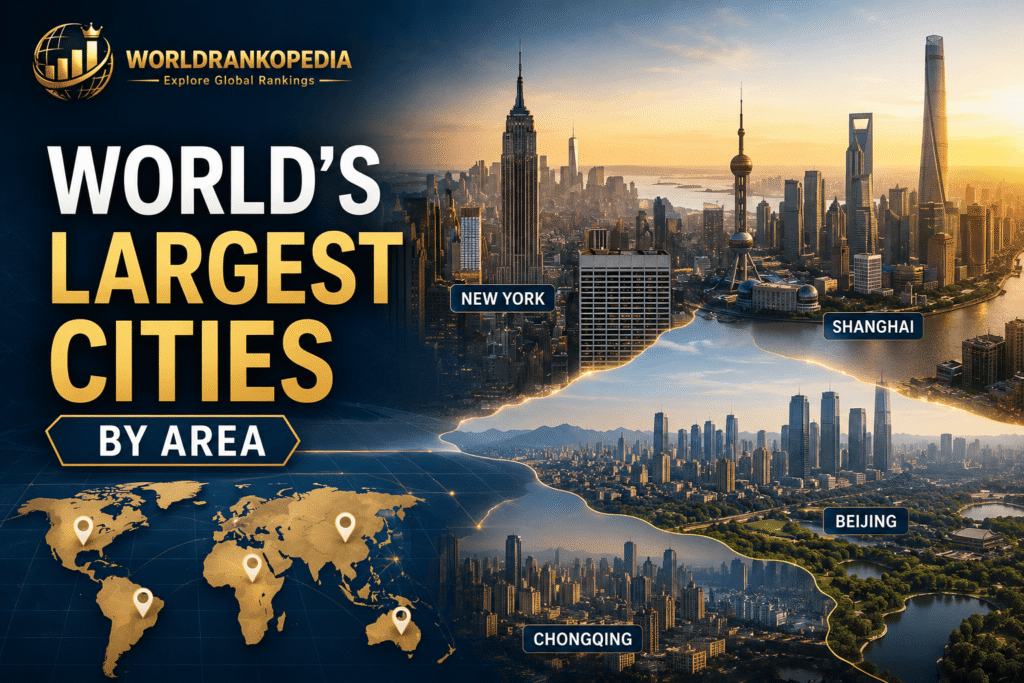
World’s Largest Cities by Area: The Urban Giants That Redefine Scale
Published on WorldRankopedia.com
When most people think about the world’s biggest cities, population usually comes to mind first — Tokyo’s 37 million residents, Delhi’s staggering density, or the non-stop energy of Shanghai. But size by area tells a completely different story. Some of the planet’s most sprawling urban landscapes are places you might never expect, spread across thousands of square kilometers of desert, tundra, coastline, and countryside.
Let’s take a journey through the world’s largest cities by area — and trust us, a few of these will genuinely surprise you.
1. Hulunbuir, China — 263,953 km²
Yes, you read that right. Hulunbuir, located in Inner Mongolia, holds the title of the world’s largest city by administrative area, covering a land mass roughly the size of the United Kingdom. It’s a place of sweeping grasslands, ancient forests, and nomadic heritage. Officially classified as a “prefecture-level city” under China’s administrative system, Hulunbuir’s sheer scale is more geographical than urban in the traditional sense — but by the numbers, nothing else on Earth comes close.
The region is home to the Hulun Lake, one of China’s largest freshwater lakes, and the Genhe Wetlands — among the most pristine in Asia. Calling it a “city” in the Western sense would be misleading, but that’s exactly what makes it fascinating. China’s administrative classifications blur the lines between urban centers and vast rural territories in ways that genuinely challenge our assumptions about what a city even is.
2. Altamira, Brazil — 159,696 km²
Deep in the heart of the Amazon lies Altamira, a municipality in the state of Pará that stretches across nearly 160,000 square kilometers of dense rainforest. If Altamira were a country, it would comfortably rank among the world’s larger nations by territory.
The city proper is a modest town along the Xingu River, but its administrative boundaries extend into some of the most biodiverse wilderness on the planet. The controversial Belo Monte hydroelectric dam project brought Altamira international attention in recent years, drawing both investment and fierce environmental debate. It’s a place caught between two worlds — the ancient and the industrial, the local and the global.
3. Qingdao, China — 11,282 km²
Shifting from administrative mega-regions to a more recognizable urban story, Qingdao on China’s eastern coast is one of the country’s most dynamic port cities. Known internationally for its German colonial architecture, world-famous Tsingtao beer, and one of Asia’s busiest harbors, Qingdao has grown enormously over the past two decades.
Its urban expansion has been relentless — new districts, industrial zones, and residential communities pushing outward into what was once farmland and coastline. Qingdao is a compelling example of how China’s economic rise has physically reshaped its cities, turning once-compact settlements into true urban sprawl at a scale that Western cities rarely match.
4. Chongqing, China — 82,400 km²
Chongqing deserves a category of its own. Often cited as the world’s most populous city (depending on how you count municipal vs. urban populations), Chongqing is a place that defies conventional urban logic. Perched at the confluence of the Yangtze and Jialing rivers, the central city is a vertically stacked maze of bridges, tunnels, and elevated highways — one of the most visually striking urban environments on Earth.
But Chongqing’s administrative area stretches across mountains, rural villages, and agricultural land that dwarf its urban core. It’s simultaneously a megacity and a rural province, a tech hub and a traditional farming community. The numbers alone don’t capture just how layered and complex this place really is.
5. Yakutsk, Russia — and Russia’s Sprawling Urban Anomalies
Russia’s vast geography produces some remarkable entries when it comes to city size by area. Yakutsk, the world’s coldest city, serves as the administrative center of the Sakha Republic — a territory so enormous it covers roughly one-fifth of Russia’s total land mass. While Yakutsk proper is relatively compact, the surrounding administrative structure inflates its footprint dramatically.
Similarly, cities like Norilsk and Magadan sit within massive administrative territories that exist more as logistical necessity in the Russian Arctic than as recognizable urban areas. These are places where infrastructure, governance, and geography intertwine in ways that defy standard urban definitions.
6. Mount Isa, Australia — 43,310 km²
Australia’s entries on this list tend to shock people. Mount Isa, a mining city in outback Queensland, covers over 43,000 square kilometers — making it one of the largest cities by area in the world outside of China and Russia. The city exists almost entirely because of the massive copper, silver, lead, and zinc deposits beneath its red earth.
The population? Around 22,000 people. The math there speaks for itself. Mount Isa is an extreme example of how geography and governance interact — a tiny population administering an enormous swath of Australian desert. It’s remote, it’s rugged, and it’s surprisingly fascinating from an urban studies perspective.
7. Karachi, Pakistan — 3,527 km²
Karachi proves that massive land area and massive population density can occasionally overlap. As Pakistan’s financial capital and largest city, Karachi packs tens of millions of residents into a coastal footprint that, while modest by the standards of this list, is enormous for a city of such density. Its rapid expansion has pushed city limits outward into areas once considered peripheral, absorbing fishing villages, industrial zones, and informal settlements into a complex, sprawling urban organism.
What Karachi lacks in sheer territorial area compared to Hulunbuir or Altamira, it more than compensates for in raw human energy and economic weight.
8. Irkutsk and Siberian Cities, Russia
Siberia’s administrative geography makes for some of the world’s most unusual urban footprints. Cities like Irkutsk function as regional capitals for territories that span time zones. Lake Baikal — the world’s deepest lake — sits within the broader Irkutsk Oblast, lending the city’s surroundings a natural grandeur that few urban centers can claim.
These Siberian cities exist partly as outposts of governance across territories where human settlement is thin, and distances between communities can be measured in the hundreds of kilometers.
What Does “Largest City” Really Mean?
Here’s the honest question this list forces us to ask: what do we actually mean when we say “city”?
The entries above range from dense urban cores with millions of residents to administrative units that govern more wilderness than neighborhoods. China’s prefecture-level city system, Brazil’s municipal boundaries, and Australia’s sprawling council territories all operate under a different logic than, say, New York City or London.
The world’s largest cities by area are, in many ways, more about governance and geography than about urban life as most people experience it. But that’s precisely what makes them worth understanding. They reveal how differently the world’s nations have chosen to organize, classify, and imagine their own territories.
Final Thoughts
The planet’s largest cities by area remind us that urbanism isn’t one thing — it’s a spectrum stretching from Chongqing’s vertical concrete jungle to Hulunbuir’s open steppe horizon. Exploring these places, even just on a map, expands our sense of what’s possible in human settlement and administration.
Next time someone asks you to name the world’s biggest city, you’ll know that the answer depends entirely on what you mean by “big.”
Explore more fascinating world rankings at WorldRankopedia.com