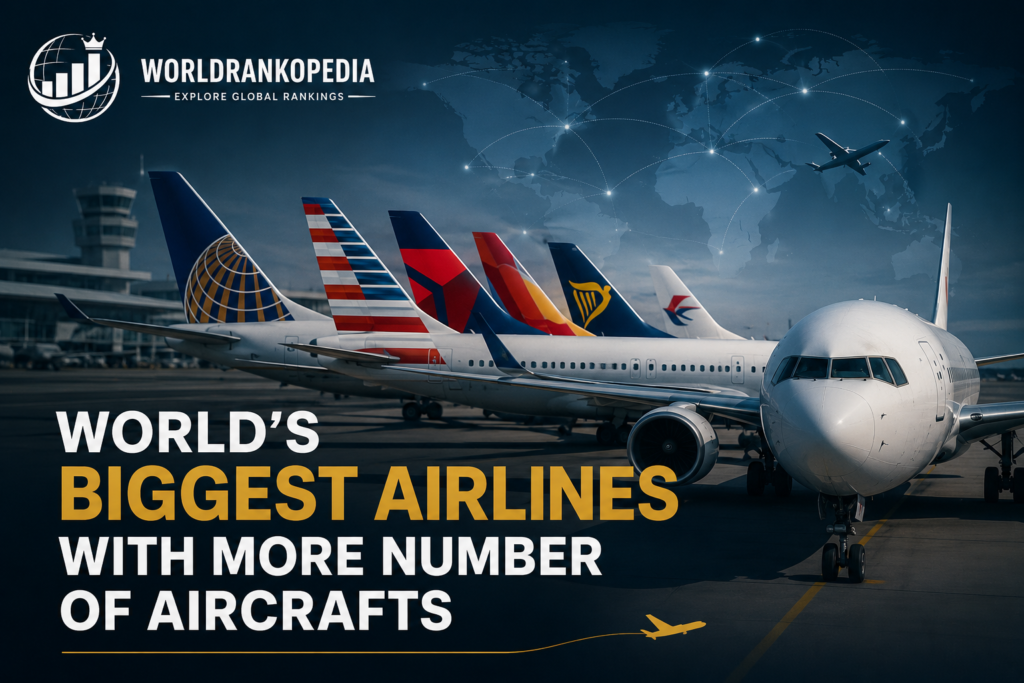
World’s Biggest Airlines by Fleet Size in 2026. The global aviation industry is larger and more competitive than ever. Each day, thousands of aircraft connect millions of passengers across continents. Airlines play a vital role in the modern world economy. Some airlines excel in luxury service or passenger numbers, while others are notable for the sheer size of their fleets. Fleet size is important because it reflects an airline’s operational power, route network, market reach, and financial strength. Airlines with larger fleets can operate more routes, provide better connectivity, and respond quickly to rising travel demand. In 2026, American carriers will primarily lead the battle for the skies, while Asian and European airlines rapidly increase their presence. Here’s a detailed look at the largest airlines in the world by number of aircraft.
1 . United Airlines
Over 1,050 Aircraft United Airlines operates the largest airline fleet in the world, with more than 1,050 aircraft in service. The airline has expanded aggressively in recent years by adding modern Boeing and Airbus jets to strengthen its domestic and international operations. ([Avio Space][1]) Founded in 1926, United Airlines is based in Chicago, USA, and serves hundreds of destinations worldwide. The airline has one of the largest wide-body fleets globally, making it a major player in long-haul international travel.
Key Highlights
Headquarters: Chicago, United States
Main Aircraft Types: Boeing 737, 777, 787, Airbus A319, A320, A321
Major Strength: Strong global route network
Destinations Served: Nearly 400 worldwide
United’s strategy focuses heavily on international expansion, premium travel experiences, and fuel-efficient aircraft.
2. American Airlines
Around 1,000 aircraft, American Airlines remains one of the most powerful names in aviation, operating a fleet of about 1,000 aircraft. Based in Fort Worth, Texas, American Airlines is known for its extensive domestic network and large international presence. The airline serves hundreds of destinations daily and operates thousands of flights every week.
Key Highlights
Headquarters: Texas, United States
Main Aircraft Types: Airbus A321, Boeing 737, Boeing 777, Boeing 787
Major Strength: Huge passenger volume and route coverage
Daily Flights: More than 6,000 American Airlines continues to invest in modern aircraft to improve fuel efficiency and passenger comfort
3. Delta Air Lines
Around 900 Aircraft. Delta Air Lines is one of the oldest and most respected airlines in the world. With a fleet approaching 900 aircraft, Delta remains a dominant player in the global aviation industry. Headquartered in Atlanta, Delta operates one of the largest airline networks worldwide. The airline is widely recognised for its reliability, customer service, and operational efficiency.
Key Highlights
Headquarters: Atlanta, United States
Main Aircraft Types: Airbus A350, A330, Boeing 737, Boeing 757
Major Strength: Premium international operations
Hub Airport: Hartsfield-Jackson Atlanta International Airport. Delta is also known for efficiently maintaining older aircraft while gradually modernising its fleet.
4. Southwest Airlines
More Than 800 Aircraft Southwest Airlines is the largest low-cost airline in the world and one of the biggest operators of Boeing 737 aircraft. The airline currently operates over 800 planes. Unlike traditional airlines, Southwest focuses mainly on domestic and short-haul routes, especially within the United States.
Key Highlights
Headquarters: Dallas, United States
Aircraft Type: Mostly Boeing 737 family
Major Strength: Low-cost travel model
Business Style: Point-to-point network Southwest succeeded by simplifying operations, cutting costs, and offering affordable fares to millions of passengers.
5. China Eastern Airlines
Around 650 Aircraft. China Eastern Airlines has become one of Asia’s aviation giants. With around 650 aircraft, the airline is rapidly expanding due to rising travel demand in China.
Key Highlights
Headquarters: Shanghai, China
Main Aircraft Types: Airbus A320 family, Boeing 737
Major Strength: Fast-growing Asian market
International Reach: Asia, Europe, North America, and Oceania. China’s growing middle class and tourism increase have helped airlines like China Eastern expand at an impressive pace.
6. SkyWest Airlines
Around 540 Aircraft. Although SkyWest may not be as globally famous as major international airlines, it operates one of the largest regional airline fleets in the world. The airline mainly partners with larger carriers such as United, Delta, Alaska Airlines, and American Airlines.
Key Highlights
Headquarters: Utah, United States
Aircraft Type: Regional jets
Major Strength: Regional connectivity
Operations: Domestic feeder services, SkyWest plays a critical role in connecting smaller cities with major airline hubs.
7. Ryanair
Ryanair, with around 450 aircraft, is Europe’s largest low-cost airline and one of the continent’s most profitable aviation companies. The Irish airline is known for its extremely low fares and rapid expansion across Europe.
Key Highlights
Headquarters: Dublin, Ireland
Main Aircraft Types: Boeing 737 family
Major Strength: Ultra-low-cost operations
Network: Hundreds of European routes. Ryanair’s business model concentrates on high passenger volume, secondary airports, and quick turnaround times.
8. China Southern Airlines
Over 400 aircraft, China Southern Airlines is another fast-growing Chinese aviation giant. It operates more than 400 aircraft and continues to grow its international network.
Key Highlights
Headquarters: Guangzhou, China
Main Aircraft Types: Airbus A320, Boeing 737, Boeing 787
Major Strength: Domestic Chinese market dominance
Expansion Focus: International long-haul growth, China Southern benefits greatly from the world’s fastest-growing aviation market.
9. IndiGo
India’s Aviation Giant India’s largest airline, IndiGo, has seen explosive growth in recent years. The airline currently operates hundreds of aircraft and continues to place record-breaking aircraft orders.
Key Highlights
Headquarters: Gurgaon, India
Fleet Size: Around 440 aircraft
Main Aircraft Types: Airbus A320neo family
Major Strength: Massive domestic demand. Experts believe IndiGo could soon become one of the top five largest airlines globally if its rapid expansion continues.
10. Turkish Airlines
Global Connector Turkish Airlines may not have the largest fleet compared to American giants, but it boasts one of the world’s widest international networks.
Key Highlights
Headquarters: Istanbul, Türkiye
Major Strength: International connectivity
Hub Advantage: Strategic location between Europe and Asia
Reputation: One of the world’s best international carriers. The airline connects more countries than almost any other airline globally. Why Fleet Size Matters: A larger fleet allows airlines to: Serve more destinations
Increase flight frequency
Handle higher passenger demand
Expand cargo operations
Improve global connectivity. However, maintaining large fleets also comes with high operational costs, including fuel, maintenance, staff salaries, airport fees, and aircraft financing. Modern airlines are now focusing not just on quantity but also on efficiency. Fuel-efficient aircraft like the Boeing 787 Dreamliner and Airbus A350 are critical for reducing costs and environmental impact.
The Future of Global Aviation. The aviation industry is expected to grow significantly over the next decade. Countries like India, China, Saudi Arabia, and the UAE are investing heavily in aviation infrastructure and airline expansion. At the same time, sustainability is becoming a major challenge. Airlines face pressure to cut carbon emissions, update fleets, and use sustainable aviation fuels. Despite economic fluctuations and fuel price challenges, global air travel demand continues to rise. This means competition among the world’s largest airlines is likely to become even more intense in the coming years.
Final Thoughts:
The world’s largest airlines are much more than transportation companies. They symbolise economic power, technological progress, and global connectivity. While American Airlines still leads in fleet size, Asian and Middle Eastern carriers are quickly closing the gap. As travel demand grows and new aircraft technologies emerge, the rankings of the largest airlines could shift dramatically in the future. One thing is clear: the race for the skies is far from over.