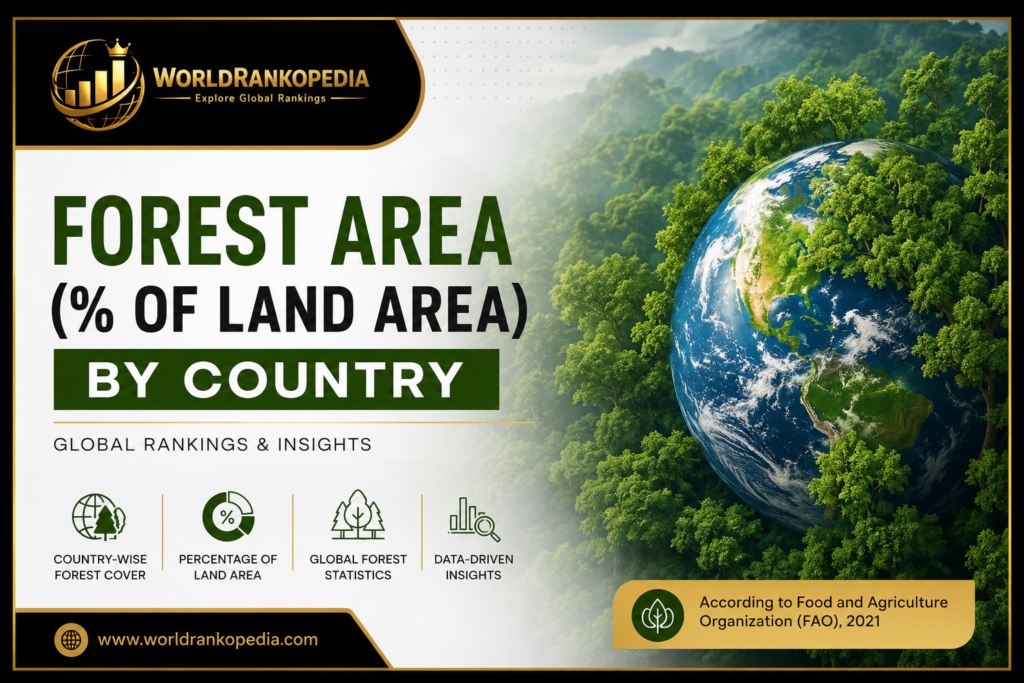
Forests are often called the “lungs of the Earth” — and for good reason. They absorb carbon dioxide, release oxygen, support wildlife, regulate climate, and provide livelihood to millions of people. But the distribution of forests around the world is not equal. Some countries are almost entirely covered in dense green landscapes, while others have very little natural tree cover left.
According to the Food and Agriculture Organisation (FAO), forest area refers to land covered by naturally growing or planted trees that are at least 5 meters tall, excluding agricultural plantations, fruit farms, and urban parks.
On average, about 31% of the world’s land is covered by forests, but country-wise numbers vary dramatically.
Let’s explore the nations where forests dominate the land.
🌲 Top Forested Countries in the World
At the very top of the list, we find countries where nature still rules most of the land:
Suriname leads the world with an astonishing 97.3% forest coverage, meaning almost the entire country is wrapped in tropical rainforest. Nearby Guyana (93.5%) and Gabon (91.3%) also stand out as global green giants.
These countries are home to dense Amazonian and Central African rainforest ecosystems, which play a huge role in storing carbon and maintaining global climate balance.
🌍 Europe’s Green Heartlands
Europe also has several highly forested countries, especially in the north and east.
Finland (73.7%) and Sweden (68.7%) are known for their endless pine forests, lakes, and cold wilderness. Slovenia and Montenegro also surprise many people with over 60% forest coverage each.
These forests are not just scenic — they are deeply integrated into local economies, especially in timber, tourism, and biodiversity conservation.
🌿 Asia’s Forest Balance
Asia shows a mixed picture.
Japan (68.4%) and South Korea (64.3%) have maintained significant forest cover despite high population density. Indonesia (48.4%) and Vietnam (47%) still hold vast tropical forest areas, although deforestation remains a concern in some regions.
China and India, two of the world’s largest countries, both sit at around 23–24% forest cover, but both have been actively increasing tree plantation and reforestation efforts in recent years.
🌎 The Americas: From Rainforest to Temperate Forests
South America is one of the richest forest regions on Earth.
Brazil alone holds about 59.3% forest coverage, mostly due to the Amazon rainforest. Colombia and Venezuela also maintain over 50% forested land.
In North America, Canada (39.5%) leads with vast boreal forests, while the United States stands at about 33.9%, showing a balance between forests, agriculture, and urban development.
🌵 Low Forest Regions of the World
At the opposite end of the spectrum are countries where forests are naturally scarce or heavily reduced due to climate and geography.
Egypt has 0% forest cover, while Saudi Arabia has only 0.5%, mainly due to desert landscapes. Afghanistan, UAE, and Israel also have very limited forest areas.
Pakistan has around 4.8% forest cover, highlighting a growing need for reforestation and environmental protection efforts.
🌐 Why Forest Coverage Matters
Forest percentage is not just a number — it reflects a country’s environmental health. High forest cover usually means:
- Better air quality 🌬️
- Strong biodiversity 🐾
- Climate stability 🌦️
- Natural disaster protection 🌧️
On the other hand, low forest coverage often leads to soil erosion, heat extremes, and ecological imbalance.
🌏 Final Thoughts
The global forest map shows a clear contrast: some countries are naturally rich in forests, while others struggle with limited green cover.
With rising climate challenges, protecting existing forests and increasing reforestation efforts is becoming more important than ever.
Because at the end of the day, forests are not just trees — they are life support systems for the entire planet.
📊 Source: Food and Agriculture Organisation (FAO), Global Forest Resources Assessment (latest available data)