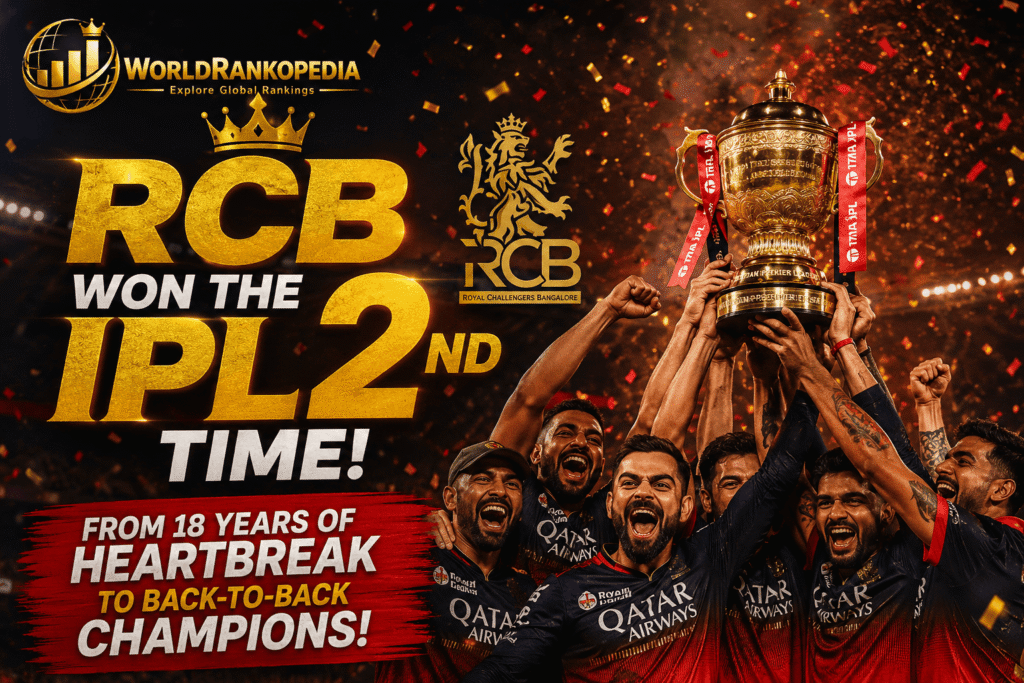
Royal Challengers Bengaluru didn’t just win the IPL twice in a row — they rewrote the story of one of cricket’s greatest nearly-there franchises. IPL 2026 Final | Ahmedabad
There is a particular kind of suffering that only long-suffering cricket fans truly understand — the sort that builds across seasons, across decades, layer upon layer, like sediment. For fans of Royal Challengers Bengaluru, that suffering had a very specific duration: eighteen years. Eighteen seasons of jaw-dropping highs, brutal near-misses, and a growing suspicion that maybe, just maybe, the trophy wasn’t meant for them. And then, in the span of just twenty-four months, all of it was washed away.
On June 1, 2026, at the Narendra Modi Stadium in Ahmedabad, RCB completed one of the most extraordinary back-to-back title defences in the history of the Indian Premier League — defeating Gujarat Titans by five wickets to lift the IPL trophy for the second consecutive year. In doing so, they became only the third franchise ever to successfully defend the IPL crown, joining the legendary dynasties of MS Dhoni’s Chennai Super Kings (2010–11) and Rohit Sharma’s Mumbai Indians (2019–20).
A Final That Told the Whole Story
RCB, after winning the toss, sent the Gujarat Titans in to bat — a decision that looked increasingly correct with each passing over. GT’s top order never settled. Josh Hazlewood removed captain Shubman Gill for just ten runs in the third over, while Bhuvneshwar Kumar, playing what many believe could be the twilight years of a brilliant career, bowled Sai Sudharsan out cheaply immediately after. The Gujarat innings never recovered its footing.
Washington Sundar, promoted down the order, played a gritty cameo to finish unbeaten on fifty — but it was very much a lone hand. Young Nishant Sindhu chipped in with twenty before Rasikh Salam Dar, the Kashmiri quick who has become one of the most exciting fast-bowling talents in the competition, took apart the middle order with figures of three for twenty-seven. GT limped to 155 for eight — a total that, on most pitches, in most finals, would feel inadequate.
“After being without the trophy for eighteen years, this franchise has now become an absolute beast. Two titles in two years — nobody saw this coming, but everyone will remember it forever.”
The chase began at warp speed. Virat Kohli and Venkatesh Iyer came out swinging, attacking Kagiso Rabada — one of the most fearsome pacers in world cricket — and pummelled him for 37 runs in just his first two overs. By the time the powerplay ended, RCB were flying at 70 for two. Then came the wobble that always makes a final feel like a final.
Rashid Khan, GT’s match-winning Afghan spinner and arguably the most dangerous T20 bowler on the planet, delivered a hammer blow — dismissing both Rajat Patidar and Krunal Pandya within the same over to reduce RCB to 91 for four. The GT dressing room sensed a way back. The stadium held its breath. And that is when Virat Kohli, in the manner only he can, simply took over.
Kohli: The Constant, the Carrier, the Champion
There is a version of this RCB story that has no happy ending without Virat Kohli. In 2025, it was Kohli who played the innings that turned the campaign. In 2026, when the final threatened to twist against them, it was Kohli again — steadying, accelerating, and then ending the game with the authority of someone who has simply been here before.
He brought up his half-century in just twenty-five balls — the fastest of his entire IPL career. He eventually walked off unbeaten on 75 from 42 deliveries, striking nine fours and three sixes. RCB crossed the line with two overs to spare. Kohli was named Player of the Match, lifting the trophy alongside skipper Rajat Patidar under the floodlights of Ahmedabad, confetti raining down in red and gold.
🏏 Final Match Highlights
- Hazlewood removed GT captain Shubman Gill for 10 in the third over, setting up RCB’s dominance
- Washington Sundar’s fighting 50* (37 balls) was the only real resistance from GT’s batting lineup
- Rasikh Salam Dar’s 3/27 was the bowling performance of the match from RCB’s attack
- Kohli and Venkatesh Iyer’s 62-run opening stand set a blazing platform for the chase
- Rashid Khan took 2 wickets to briefly bring GT back — but Kohli crushed that revival
- Kohli’s 75* (42 balls) — his fastest IPL half-century ever — sealed the victory with 12 balls to spare
- Tim David provided crucial support at the end, ensuring no late nerves crept in
The Long Road to Dynasty
To understand what this means, you need to go back further than 2025. For eighteen full seasons, RCB were the franchise that always had the firepower but somehow couldn’t finish the job. They had arguably the greatest batsman of his generation at the top of their order for years. They had match-winners throughout their squad. And yet the trophy always slipped away — in heartbreaking finals, in nail-biting playoffs, in campaigns that promised everything and delivered nothing.
That changed when IPL 2025 began. Under first-time IPL captain Rajat Patidar, RCB played a brand of cricket that was structured, disciplined, and devastatingly effective. They won their maiden IPL crown by defeating Punjab Kings in the 2025 final — ending that eighteen-year drought in scenes of jubilation that swept across Bengaluru. There were grown men in tears. There were old fans who had waited their entire adult lives for that moment.
But here is the thing about dynasties — they’re not made by winning once. They’re made by doing it again when the whole world is watching, when every team has studied you, when the pressure of defending carries its own unique weight. Only CSK and MI had done it before. Both are franchises with legendary status, legendary coaches, and legendary structures. For RCB — still relatively fresh to winning — to join them is a monumental statement of intent.
Captain Patidar: The Quiet Architect
It would be easy, and entirely reasonable, to let Virat Kohli dominate this conversation — he always does. But this team’s back-to-back glory belongs equally to Rajat Patidar, a player who took charge of one of cricket’s most iconic franchises with no previous IPL captaincy experience and delivered a title in his very first season. Then, when the pundits said defending would be the hard part, he delivered again.
Patidar leads with a calm that contrasts starkly with the passion that defines RCB’s fanbase. He makes decisions clearly, backs his players openly, and has a gift for reading the game in real time. Against GT in the final, his decision to field first — reading the pitch and the conditions — was the move that ultimately gave RCB control before a ball had been bowled in the chase. These are the quiet, unremarkable-sounding decisions that captains who win trophies make.
The Bowling Unit That Changed Everything
For much of their history, RCB were perceived as a batting team that occasionally got some bowling done. Two back-to-back titles have put that narrative firmly to bed. This is now a squad with genuine, varied, and match-winning bowling options.
Bhuvneshwar Kumar — who has been everything from young sensation to forgotten man to senior statesman over the years — brought experience and craft to this attack, regularly hitting his lengths when it mattered. Josh Hazlewood provided the new-ball menace and the ability to take wickets in the powerplay, as he did by dismissing Shubman Gill in the final. And Rasikh Salam Dar, still young but already performing on the biggest stages, looked like a player who will be a fixture in IPL finals for years to come.
It is this bowling depth — the ability to take wickets at different points in an innings, with different styles — that separates this RCB from every previous incarnation of the franchise.
Gujarat Titans: Too Classy for a Quiet Night, but Not Enough
Full credit must go to the Gujarat Titans for reaching the final. Shubman Gill has built a formidable squad, and on a different evening, with a different batting performance in the first innings, the story could have ended very differently. Their loss in this final continues a frustrating pattern — GT have now lost two finals in the last four seasons, both times at the Narendra Modi Stadium. That weight of near-miss will sit uncomfortably with their squad, but they will be a team to fear again in 2027.
It is also worth noting that the broader 2026 season produced one of the most exciting individual campaigns ever seen in IPL history. Vaibhav Sooryavanshi, the fifteen-year-old teenager from Bihar playing for Rajasthan Royals, scored 776 runs at a strike rate of over 237 — winning the Orange Cap, the Most Valuable Player award, and several other honours. At just fifteen years and sixty-five days old, he became the youngest Orange Cap winner the tournament has ever seen. His story deserved its own spotlight, even amid RCB’s history-making triumph.
What This Means for Indian Cricket
The IPL has always been more than a cricket tournament — it is the mirror in which India sees its own ambitions, passions, and possibilities reflected in it. RCB, with their enormous fanbase, their passionate home city, and their years of tortured near-misses, represent something very specific to a huge number of people: the idea that persistence, if sustained long enough, eventually delivers.
Two IPL trophies in two years do not just cement RCB as a genuine franchise power. It signals to every young cricketer who dreams in red and gold that this is now a club built to win, not just to entertain. The culture has shifted. The structure is in place. The hunger — as evidenced by the way they played throughout 2026 — has not been satisfied by success. If anything, it has grown.
“Winning once breaks a drought. Winning twice proves it wasn’t luck — it proves it’s a dynasty.”
Final Thoughts: The Red Army Has Its Dynasty
When the stumps were drawn, the confetti still settling on the Ahmedabad turf, Virat Kohli stood at the centre of the celebration — arms outstretched, eyes closed for a moment, absorbing something that must feel surreal even now. Not just one title. Two. Back to back. Against all the narrative, against the expectations management, against the accumulated weight of eighteen years of drought.
This RCB team is not finished. If anything, the hunger in Rajat Patidar’s eyes during that presentation ceremony suggested they are only just getting started. The question now is not whether RCB belongs among the great IPL franchises. They proved that in 2025. The question heading into 2027 is whether they can do something that no team in IPL history has ever done: win three titles in three consecutive seasons.