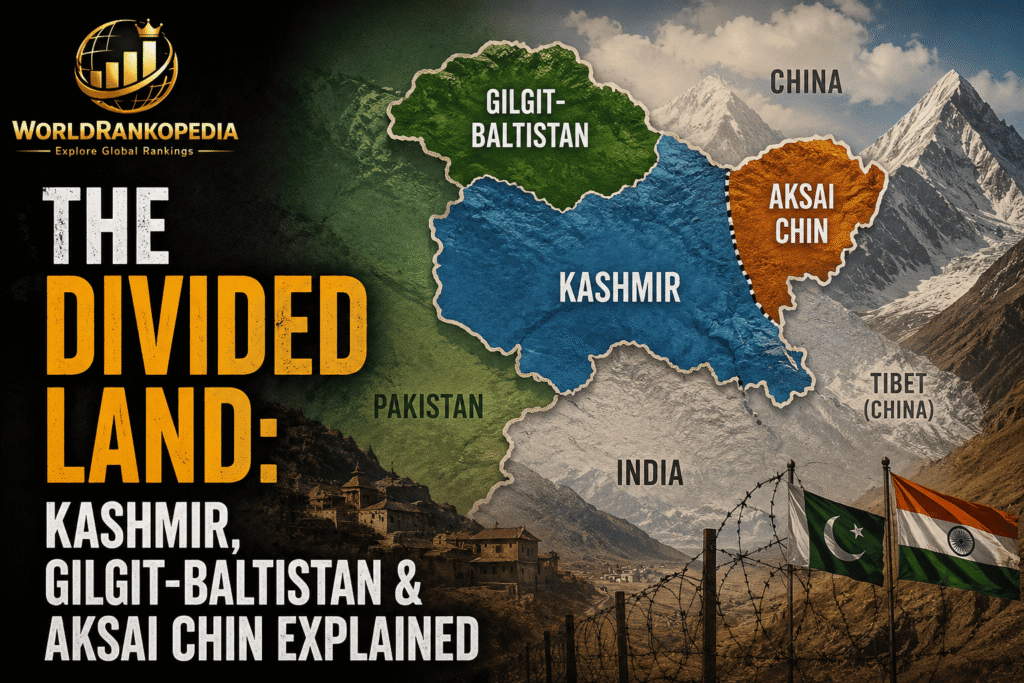
The Divided Land: Kashmir, Gilgit-Baltistan & Aksai Chin Explained
One princely state. Three powerful neighbors. A conflict that has shaped the subcontinent for over 75 years — and shows no sign of resolution.
India administers
Jammu & Kashmir + Ladakh
≈ 101,387 km²
Pakistan administers
AJK + Gilgit-Baltistan
≈ 86,000 km²
China administers
Aksai Chin
≈ 38,000 km²
This article is your complete guide to understanding who controls what, how the division happened, and why any of this still matters in 2026.
Background · 1947
Before the Division: One State, One Maharaja
To understand the split, we have to go back to 1947 — the year the British Empire packed its bags and left the Indian subcontinent. In the chaos and grief of Partition, the subcontinent was divided into two new nations: India and Pakistan. Hundreds of princely states were asked to choose sides.
One of the largest was the Princely State of Jammu and Kashmir — a vast territory of roughly 222,236 square kilometres ruled by Maharaja Hari Singh, a Hindu king presiding over a Muslim-majority population. The Maharaja hesitated. He wanted independence for his kingdom, belonging to neither of the new countries.
That hesitation would cost him everything. In October 1947, tribal militias from what is now Pakistan — backed by the Pakistani military — crossed into Kashmir to seize it by force. The Maharaja, desperate for military help, signed the Instrument of Accession on October 26, 1947, formally joining India. Indian troops airlifted into Srinagar the next morning. The first Indo-Pakistani war had begun.
When a UN-brokered ceasefire was finally declared on January 1, 1949, the fighting stopped — but no final settlement was ever reached. The ceasefire line, later called the Line of Control (LoC), became the de facto border. And the division that began in blood has lasted, in essentially the same form, for over seven decades.
- 1947 Partition of British India. Maharaja Hari Singh signs the Instrument of Accession with India after the Pakistani tribal invasion. The First Kashmir War begins.
- 1949 UN-brokered ceasefire. Line of Control established. Pakistan occupies roughly one-third of the former princely state.
- 1962 Sino-Indian War. China seizes Aksai Chin after India discovers a Chinese military road built secretly through the territory.
- 1965 Second Indo-Pakistani War over Kashmir. Inconclusive. Tashkent Agreement signed.
- 1972 Simla Agreement formalises the Line of Control. Both countries agree to resolve disputes bilaterally.
- 1999 Kargil War. Pakistani soldiers and militants occupy Indian positions in Kargil. Forced back after intense fighting.
- 2019 India revokes Article 370, removing Jammu & Kashmir’s special autonomous status. The state is reorganised into two Union Territories.
- 2024 China creates two new administrative counties — He’an and Hekang — covering the Aksai Chin plateau, deepening its administrative control.
Part One · India
What India Controls: Jammu & Kashmir and Ladakh
India’s portion of the former princely state is the largest by population and arguably the most famous. It stretches from the rolling plains of Jammu in the south, through the legendary Kashmir Valley in the centre, all the way to the high-altitude desert of Ladakh in the east.
The Kashmir Valley
When the world pictures Kashmir, it usually pictures this: houseboats drifting on Dal Lake, saffron fields in autumn, Mughal gardens softened by mist. The Kashmir Valley is roughly 135 kilometres long and about 32 kilometres wide — a small, breathtaking bowl of civilization cradled by mountains. It has been called the “Switzerland of Asia” by visitors for centuries.
Today, it is the administrative heart of the Union Territory of Jammu & Kashmir, with Srinagar as its summer capital and Jammu as its winter capital. The population is predominantly Muslim, and the region has a long and complicated history of insurgency, human rights debates, and political tension with the Indian central government.
The 2019 Change: Article 370 Revoked
For decades, India’s Jammu & Kashmir held a special status under Article 370 of the Indian Constitution, which granted it significant autonomy — its own flag, its own laws, and restrictions on non-residents buying land. In August 2019, the Indian government, led by Prime Minister Narendra Modi, scrapped this provision in a dramatic move that sent shockwaves across the region.
The former state was divided into two Union Territories directly governed from New Delhi: Jammu & Kashmir (with a legislature) and Ladakh (without one). India described this as a step toward development and integration. Pakistan and local Kashmiri leaders condemned it as an illegal annexation.
Ladakh: The High Desert
Ladakh is an extraordinary place — a cold desert at altitudes between 2,750 and 5,300 metres, where Buddhist monasteries cling to cliffsides and the Indus River carves valleys through lunar terrain. Since becoming a separate Union Territory in 2019, it has had no elected legislature, which has sparked protests from Ladakhi leaders demanding statehood and constitutional protections.
Ladakh also borders the Chinese-controlled Aksai Chin — making it a military frontline. The deadly 2020 Galwan Valley clash between Indian and Chinese troops took place in Ladakh, highlighting how geographically and strategically vital this territory remains.
India
Jammu & Kashmir
Union Territory since 2019. Legislature present. Summer capital: Srinagar. Winter capital: Jammu. Predominantly Muslim in the Valley, mixed in Jammu.
India
Ladakh
Union Territory since 2019. No legislature. High-altitude Buddhist & Muslim region. Borders China’s Aksai Chin along the Line of Actual Control.
Part Two · Pakistan
What Pakistan Controls: Azad Kashmir & Gilgit-Baltistan
Pakistan’s portion of the former princely state consists of two distinct territories with very different legal statuses — but which share the same fundamental reality: they are governed by Pakistan, claimed by India, and their final destiny remains unresolved.
Azad Jammu & Kashmir (AJK)
The name itself is a political statement. “Azad” means “free” in Urdu — yet critics point out that the territory functions as anything but an independent state. Azad Jammu & Kashmir stretches along Pakistan’s northeastern border, covering roughly 13,297 square kilometres. Its capital is Muzaffarabad.
On paper, AJK has its own government, its own president, its own prime minister, and its own legislative assembly. In practice, major decisions are heavily influenced by Islamabad. It is not a province of Pakistan — it has a unique “self-governing” status — but it is also not internationally recognised as an independent state. India refers to it as “Pakistan-Occupied Kashmir” or “POK.” Pakistan insists it represents the aspirations of the Kashmiri people.
Gilgit-Baltistan: The Mountain Kingdom
North of AJK lies one of the most staggeringly beautiful territories on Earth. Gilgit-Baltistan — once called the Northern Areas — covers approximately 72,971 square kilometres of mountains, glaciers, and high valleys. It is home to some of the world’s highest peaks, including K2, Nanga Parbat, Broad Peak, and Gasherbrum — four of the fourteen mountains in the world above 8,000 metres. For mountaineers, this is sacred ground.
Administratively, Gilgit-Baltistan is divided into ten districts across three divisions: Gilgit Division, Baltistan Division, and Diamer Division. Its capital is Gilgit City. According to the 2023 census, the total population stands at just over 1.7 million people — small for such a large territory, which speaks to its extreme terrain.
The territory was formally renamed from “Northern Areas” to “Gilgit-Baltistan” in 2009 and given a degree of self-governance. But its constitutional status remains deeply ambiguous. It is not a formal province of Pakistan; it has no representation in Pakistan’s National Assembly, and its residents do not have the same constitutional rights as Pakistani citizens in other provinces.
India claims Gilgit-Baltistan as part of the former princely state and refers to it as part of “Pakistan-Occupied Territories of Ladakh.” China, meanwhile, has enormous strategic interest here: the China-Pakistan Economic Corridor (CPEC) — a multibillion-dollar infrastructure project — runs directly through Gilgit-Baltistan, connecting China’s Xinjiang region to the Pakistani port of Gwadar on the Arabian Sea.
Pakistan
Azad Jammu & Kashmir
≈ 13,297 km². Capital: Muzaffarabad. Has its own president, PM & assembly — but major policy is tied to Islamabad. Not an official province.
Pakistan
Gilgit-Baltistan
≈ 72,971 km². Capital: Gilgit. Home to K2 & major Himalayan peaks. The CPEC corridor passes through here. Renamed from “Northern Areas” in 2009.
Part Three · China
What China Controls: Aksai Chin
If Gilgit-Baltistan is a mountaineer’s paradise, Aksai Chin is something closer to the moon. Sitting at an average elevation of around 5,000 metres, this high-altitude salt plateau is one of the world’s most desolate landscapes — no permanent settlements, almost no rainfall, freezing winds year-round, and a silence so complete it can feel unsettling.
Yet this barren emptiness has been the site of one of Asia’s most consequential territorial disputes.
The Road That Changed Everything
In the 1950s, China quietly built a military highway — the G219 National Highway — across the Aksai Chin plateau. The road connected its restive western regions of Tibet and Xinjiang, giving Beijing an overland route it desperately needed for military logistics. The problem? China built the road through territory that India considered its own.
India discovered the road’s existence in 1957, after it was already complete. Protests followed. Diplomatic tension escalated into the Sino-Indian War of 1962, a brief but humiliating conflict for India that ended with China firmly in control of approximately 38,000 square kilometres of Aksai Chin. That control has never been reversed.
Why China Won’t Let Go
For China, Aksai Chin is not about sentiment or history. It is about geometry. The territory bridges Tibet and Xinjiang — two regions Beijing considers essential to national unity and security. Without Aksai Chin, those regions are effectively disconnected from each other by land. The road that runs through it remains a critical military artery. Giving it up is, from Beijing’s perspective, simply not an option.
India, for its part, insists that Aksai Chin is an integral part of Ladakh — and therefore of India — illegally occupied since 1962. This remains one of the core unresolved issues in Sino-Indian relations.
2024: China Deepens Administrative Grip
In December 2024, China made a significant administrative move. It announced the creation of two brand-new counties — He’an County and Hekang County — under the Hotan Prefecture of Xinjiang, covering virtually the entire Aksai Chin plateau. India’s Ministry of External Affairs sharply condemned the decision, calling it a unilateral attempt to change the status quo. China pressed ahead regardless.
This was not a military escalation — no shots were fired. But it signalled China’s intention to deepen its civilian and administrative control over the territory, making any future negotiations over sovereignty even more complicated.
China
Aksai Chin
≈ 38,000 km². Administered as part of Xinjiang (He’an & Hekang counties, est. 2024) and Tibet. Elevation: avg ~5,000m. Zero permanent civilian population. Vital G219 highway connects Xinjiang and Tibet. Seized from India in the 1962 war. Claimed by India as part of Ladakh.
At a Glance
The Numbers: Who Controls How Much?
The total area of the original Jammu and Kashmir princely state was approximately 222,236 km². Here is roughly how that land is distributed today:
Note: India also claims the Shaksgam Valley (gifted to China by Pakistan in 1963) and Aksai Chin. Pakistan claims the entirety of India-administered Kashmir. China claims Arunachal Pradesh, but this falls outside the Kashmir dispute proper. All figures are approximate.
The Big Picture
Why Does This Still Matter?
It is tempting to treat Kashmir as a frozen conflict — a dispute that has been argued over for so long that it has become part of the landscape, like the mountains themselves. But the stakes remain very real, and they touch billions of lives.
Nuclear-Armed Neighbours
Both India and Pakistan are nuclear-armed states. Both have fought multiple wars over this territory. The Line of Control remains one of the most militarised borders on the planet, with ceasefire violations measured in the hundreds each year. A miscalculation here is not just a regional problem — it is a global one.
Water and Climate
The glaciers of Gilgit-Baltistan and Ladakh feed the rivers that supply drinking water and agriculture to hundreds of millions of people in South Asia — the Indus, Jhelum, and Chenab among them. As climate change accelerates glacial melt, control over this water tower becomes even more strategically significant.
The China Factor
China’s deep investment in CPEC — running through Gilgit-Baltistan — has effectively made it a stakeholder in the Kashmir dispute. India objects to any infrastructure passing through what it considers its own territory. This triangular tension between India, Pakistan, and China makes resolution significantly harder than a simple bilateral negotiation.
The People Caught in the Middle
Behind every geopolitical calculation are people — Kashmiri shepherds, Balti farmers, Ladakhi monks, Gilgiti traders — who have lived through decades of conflict, displacement, and political uncertainty. Their identities, cultures, and languages are ancient and rich. Their futures remain tied to decisions made in New Delhi, Islamabad, and Beijing.
Summary
Recap: Who Rules What, Right Now
🇮🇳 India Controls
Jammu & Kashmir (UT) + Ladakh (UT)
Largest administered portion. Revocation of Article 370 in 2019 brought direct central rule. Disputed by Pakistan entirely; Aksai Chin is disputed with China.
🇵🇰 Pakistan Controls
AJK + Gilgit-Baltistan
Two separate territories. Neither is a full province. CPEC passes through GB. India calls this “Pakistan-Occupied Kashmir & Territories.”
🇨🇳 China Controls
Aksai Chin
Seized in 1962. Administered as part of Xinjiang. New counties created in 2024 to solidify administrative hold. Claimed by India as part of Ladakh.
Explore More on WorldRankopedia
This article is part of our ongoing series on the world’s most consequential territorial disputes and geopolitical flashpoints. We break down complex global issues — country by country, border by border.