Every Mobile Phone Brand Under BBK Electronics
You’ve heard of OPPO, Vivo, OnePlus, and Realme. But chances are, you’ve never heard of the single company quietly pulling the strings behind all of them.
Here’s a question worth thinking about: if you walked into a phone store today and picked up an OPPO phone in one hand and a OnePlus in the other, would you think you were holding two competing products — or two products from the same family? Most people would say competitors. And they wouldn’t be entirely wrong. But the real answer is far more interesting than that.
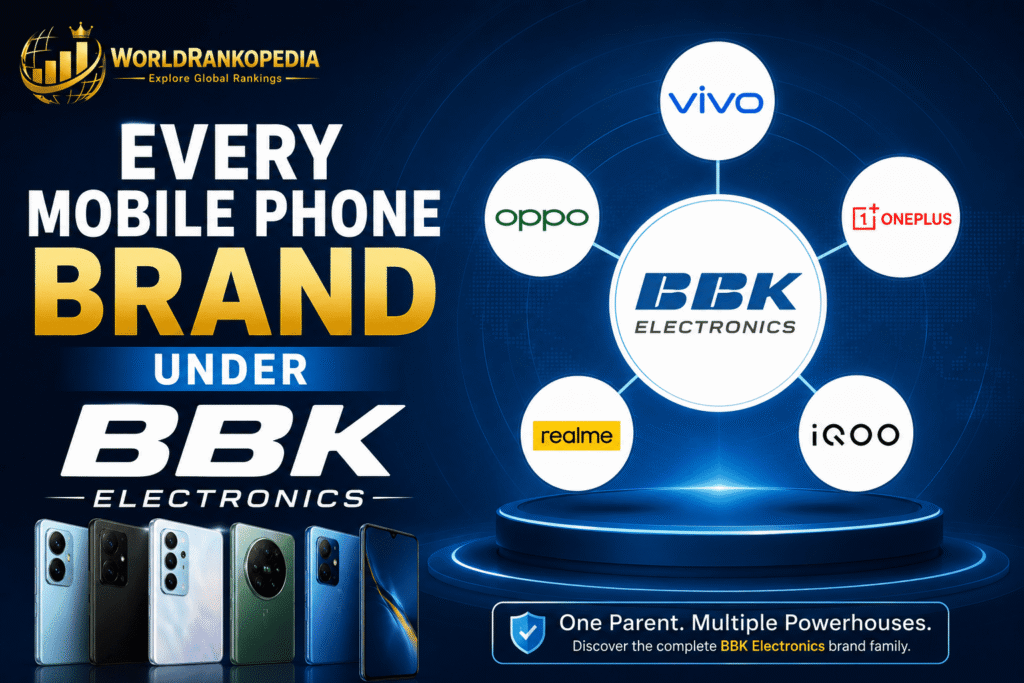
Both phones trace their roots back to a single Chinese conglomerate: BBK Electronics. And it doesn’t stop there. Vivo, Realme, and iQOO are all cut from the same cloth. Together, these five brands form one of the most audacious — and successful — multi-brand strategies the technology world has ever seen.
“BBK was never meant to be a household name. Its genius was in making everyone else famous instead.”
Who Exactly Is BBK Electronics?
If you asked a hundred smartphone buyers whether they’d heard of BBK Electronics, perhaps two or three would raise a hand. That anonymity is deliberate. Founded in September 1995 by entrepreneur Duan Yongping in the manufacturing city of Dongguan, China, BBK was never built to be a consumer-facing name. It was built to be an engine — a platform for creating brands that others would love.
In its early years, BBK made educational electronics, e-dictionaries, VCD players, and cordless phones. Solid, unglamorous products that built up a deep understanding of manufacturing, supply chains, and Chinese consumer tastes. That foundational experience would later prove invaluable when the company decided to bet big on mobile phones.
BBK Electronics formally deregistered as a corporate entity in April 2023, essentially dissolving the parent holding structure. Rather than shutting down, the move was a deliberate restructuring. Each subsidiary brand operates as a fully independent company, better positioned to navigate global regulatory scrutiny and expand on its own terms.
The Numbers Behind the Empire
Combined global smartphone market share
Major smartphone brands launched
Share of India smartphone shipments in 2024
Year BBK was founded
Those numbers deserve a second look. Nearly half of all smartphones shipped in India in 2024 came from brands that share the same DNA. In global terms, one in five smartphones sold worldwide has a BBK family connection. And yet, most buyers had absolutely no idea.
The Five Brands — What Makes Each One Tick
What’s clever about BBK’s approach isn’t just that they launched multiple brands — it’s that each brand was engineered to feel genuinely different. Different audiences, different personalities, different retail strategies. Here’s a close look at each one.
BBK’s oldest smartphone brand. Began life making DVD and Blu-ray players before pivoting to phones in 2008. Known for its stunning camera systems, ColorOS software, and fast-charging technology called SuperVOOC.
Mid-to-premium
Carved its identity around music and camera quality. Pioneered in-display fingerprint sensors for mainstream audiences. Strong in China and India, with a marketing strategy that leans heavily on cricket and film celebrity sponsorships.
Lifestyle
The rebel child of the BBK family. Built its name on the idea of a “flagship killer” — premium specifications at prices that made Samsungs and iPhones look overpriced. Its online-first, invite-only launch strategy created genuine cult status.
Flagship killer
Started as an OPPO sub-brand targeting young buyers in India before growing into a standalone force. Realme’s superpower is value — cramming specs that once lived only in expensive phones into devices that students and first-time buyers can actually afford.
Budget champion
Vivo’s gaming-focused sub-brand was born to capture the rapidly growing performance smartphone segment. iQOO phones are built around raw speed, high-refresh-rate displays, and cooling systems that can handle hours of mobile gaming without breaking a sweat.
Gaming performance
A Timeline of Quiet Expansion
The BBK story didn’t happen overnight. It unfolded across three decades of deliberate decisions, each building on the last.
So, Why Have Multiple Brands Competing with Each Other?
This is the question that baffles most people when they first learn about BBK’s structure. Why would you deliberately create five brands that sometimes target the same buyers, sell through overlapping stores, and cannibalize each other’s sales?
The honest answer is: because it works far better than the alternative. Think of it like a supermarket stocking multiple brands of cereal. Some shoppers will pick the cheapest option. Others want the one with the most protein. A few are loyal to a brand they’ve used since childhood. A single cereal brand can’t win all of those customers — but a company that owns several brands absolutely can.
BBK’s strategy has a similar logic. If a buyer in India walks away from a Vivo phone disappointed, there’s a good chance they’ll end up with a Realme or OPPO instead. The parent company wins either way. This is sometimes called a “portfolio hedge,” and in practice it has proven remarkably resilient — when one brand loses momentum in a region, another absorbs the demand.
“The brands share DNA — supply chains, R&D insights, fast-charging breakthroughs — but they’re each dressed in completely different clothes when they face the customer.”
What These Brands Actually Share (Behind the Scenes)
Strip away the branding and marketing, and you’ll find something fascinating: a lot of shared engineering beneath the surface. All five brands benefit from shared research into areas like fast-charging technology — innovations like 100W+ charging trickled across the entire portfolio within a relatively short window once the underlying tech was cracked.
Similarly, advances in camera systems, display technology, and manufacturing efficiency are essentially distributed across all brands, giving each one access to innovations that individual companies would struggle to fund independently. This shared R&D model is one reason BBK brands have historically been able to undercut rivals on price without compromising on hardware specs — the development cost is spread across millions more units.
Software support is where the brands diverge more noticeably. As of 2024, OnePlus and OPPO commit to four major Android version upgrades plus five years of security patches, while Realme offers a somewhat shorter window of three major updates and four years of security support. Vivo and iQOO vary more by region. For a buyer who keeps phones for several years, that distinction matters.
The India Story — Where BBK Truly Dominates
No market tells BBK’s story better than India. For years, Xiaomi was the headline name in India’s budget smartphone segment, and the media treated it as the undisputed king. The truth was considerably more complicated. Vivo and OPPO were already formidable forces, spending lavishly on cricket sponsorships and setting up an enormous offline retail network across towns that online-first brands couldn’t reach.
Then Realme arrived. It was built almost specifically to fight Xiaomi on its own turf — online, price-aggressive, and aimed squarely at young Indian consumers. It rose faster than almost any smartphone brand in the country’s history. Add iQOO’s growing appeal among gaming enthusiasts and OnePlus’s premium positioning, and by 2024, BBK-linked brands collectively accounted for roughly 46% of all smartphone shipments in India. Nearly half a market, captured through five different doors.
The 2023 Restructuring — Independence Day for Five Brands
The formal deregistration of BBK Electronics as a corporate entity in April 2023 raised some eyebrows, but it wasn’t a collapse — it was an evolution. With OPPO and Vivo continuing as the primary successors to the group’s legacy, and each brand operating with significantly more independence, the restructuring was really about preparing for a more complex global landscape.
Regulatory pressure, concerns about supply chain dependencies, and the geopolitical tightrope that Chinese tech companies walk in markets like India and Europe all played a role. By decoupling the formal corporate ties, each brand gained more flexibility to form local partnerships, navigate government requirements, and present itself as genuinely independent companies rather than subsidiaries of a Chinese conglomerate.
What Does This All Mean for You as a Buyer?
Practically speaking, knowing the BBK connection shouldn’t necessarily change which phone you buy — but it should inform how you think about the choice. A Realme and an OPPO at similar price points will share a surprising amount of component DNA; the differences are more about software experience, brand positioning, and the priorities each company has been told to chase in its respective segment.
For most everyday users — calls, messaging, social media, photography, streaming — any of the five brands will serve well. The gap between them, in raw functional terms, is narrower than the marketing suggests. Where differences genuinely emerge is in long-term software support, camera tuning philosophy, and how well each brand’s after-sales service network covers your particular geography.
The bottom line: you’re almost certainly getting solid value whichever door you walk through. That’s not an accident. It’s the whole point.
Final Thoughts
BBK Electronics built something that most technology companies never manage: a genuine empire, invisible to the people it serves. By nurturing five distinct brands across different segments, price points, and audiences, it quietly captured a fifth of the global smartphone market without ever putting its own name on a single device.
The story is also a masterclass in long-term thinking. None of this happened in a product cycle or two. It took 28 years of patient investment, calculated brand launches, and the discipline to let each subsidiary develop its own identity rather than slapping a single logo on everything and calling it a day.
The next time someone asks whether you’d prefer a Vivo or a Realme, you now know the full story. They’re cousins, not strangers. And the quiet figure at the head of the family table — even if it’s no longer officially standing — shaped both of them more than either would probably care to admit.