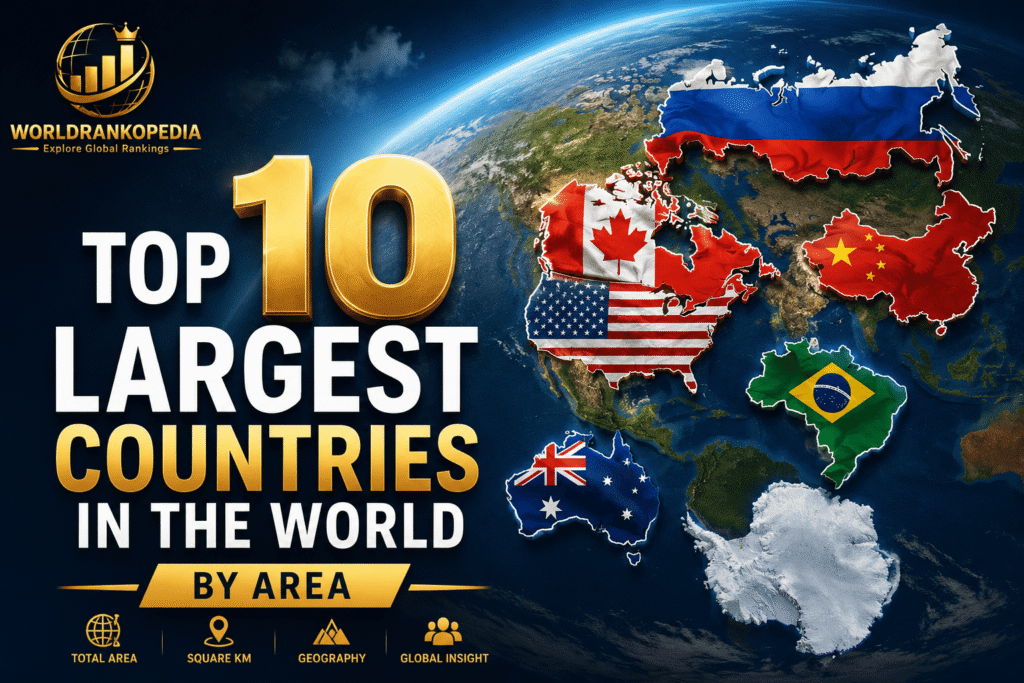
Top 10 Largest Countries in the World by Area
Published on WorldRankopedia.com
Have you ever looked at a world map and wondered just how massive some of those countries really are? We see outlines and colors on a flat page, but the sheer scale of the world’s biggest nations is almost impossible to wrap your head around. Together, the top 10 largest countries by area cover more than half the planet’s total land surface — and each one holds a story worth telling.
Let’s take a journey across the globe and explore these giants, one by one.
1. Russia — 17.1 Million km²
Russia isn’t just the largest country in the world — it’s in a league entirely its own. Stretching from Eastern Europe all the way to the Pacific Ocean, Russia spans 11 time zones. Think about that for a second: when people in Moscow are waking up for work, residents in Vladivostok are already heading to bed. Russia encompasses the world’s largest forest (the Siberian taiga), the world’s deepest lake (Baikal), and some of the planet’s most punishing winters. It’s enormous in every sense of the word.
2. Canada — 9.98 Million km²
Contrary to what many assume, Canada — not the United States — is the second largest country on Earth. Yet despite all that space, Canada’s population sits at just around 38 million people, making it one of the least densely populated nations globally. Most Canadians cluster near the southern border, leaving vast stretches of boreal forest, tundra, and Arctic wilderness virtually untouched. It’s a land of extraordinary natural beauty, from the Rocky Mountains in the west to the Maritime coastlines in the east.
3. United States — 9.83 Million km²
The United States comes in a very close third, nearly matching Canada in total area. What sets the US apart is its remarkable diversity — geographically, climatically, and culturally. Within its borders, you’ll find tropical beaches in Hawaii, Arctic conditions in Alaska, scorching deserts in Arizona, and dense forests in the Pacific Northwest. Few countries offer such a dramatic range of landscapes packed into a single nation.
4. China — 9.6 Million km²
China is the world’s most populous country and the fourth largest by area. It’s a land of contrasts — the towering Himalayas in the southwest, the Gobi Desert in the north, fertile river valleys in the east, and lush subtropical regions in the south. China’s geography has shaped thousands of years of civilization, and today, it remains one of the most geographically complex nations on the planet.
5. Brazil — 8.5 Million km²
Brazil dominates South America both in size and personality. It occupies nearly half of the entire continent and is home to the Amazon Rainforest — the largest tropical rainforest on Earth and a critical engine of the planet’s climate system. Brazil’s geography ranges from vast wetlands (the Pantanal) to dramatic coastlines stretching over 7,000 kilometers along the Atlantic Ocean. It’s wild, beautiful, and endlessly fascinating.
6. Australia — 7.69 Million km²
Australia is unique in being both a country and a continent. It’s also one of the world’s driest inhabited places — the vast Outback covers most of the interior, a rugged expanse of desert and scrubland that few people call home. Yet Australia’s coastal regions are among the most liveable and vibrant on Earth. The country is famous for its unique wildlife — kangaroos, koalas, wombats — species found nowhere else in the world.
7. India — 3.29 Million km²
India might rank seventh in total area, but in almost every other measure, it punches far above its weight. With over 1.4 billion people, it is the world’s most populous country. India’s geography is staggeringly varied: the snow-capped peaks of the Himalayas in the north, the fertile Gangetic plains through the heartland, the arid Thar Desert in the west, and tropical coastlines wrapping around the south. Few countries pack this much diversity into their borders.
8. Argentina — 2.78 Million km²
Argentina stretches from the subtropical north all the way down to the windswept tip of South America — Patagonia — one of the world’s most remote and breathtaking regions. It’s a country of stunning contrasts: the Andes along its western edge, the flat, fertile pampas grasslands at its core, and the dramatic landscapes of Tierra del Fuego in the far south. Argentina is also home to Aconcagua, the highest peak in both the Western and Southern hemispheres.
9. Kazakhstan — 2.72 Million km²
Often overlooked in global conversations, Kazakhstan is enormous — the world’s largest landlocked country. It stretches across the heart of Central Asia, covering steppes, deserts, and mountain ranges. Once part of the Soviet Union, Kazakhstan has become an increasingly important player on the world stage, with vast reserves of oil, natural gas, and minerals buried beneath its sweeping plains.
10. Algeria — 2.38 Million km²
Algeria rounds out our top ten and holds the title of Africa’s largest country. The majority of Algeria’s territory is covered by the Sahara Desert — the world’s largest hot desert — which makes up roughly 80% of the country’s land. Despite this, Algeria has a rich cultural heritage shaped by Berber, Arab, and French influences, and its northern coastal region along the Mediterranean is both fertile and historically significant.
Why Does Size Matter?
Beyond satisfying curiosity, understanding a country’s size helps us appreciate the challenges and opportunities these nations face. Large countries often have incredible natural resource wealth, but struggle with connecting remote populations. They hold extraordinary biodiversity but also carry enormous environmental responsibility.
The world’s ten largest countries alone account for roughly 49% of Earth’s total land area. They house some of the planet’s most iconic landscapes, most diverse ecosystems, and most complex societies.
Whether you’re a geography enthusiast, a curious traveler, or just someone who loves fascinating facts, these ten giants are worth knowing — because in many ways, they shape the world the rest of us live in.
Enjoyed this article? Explore more global rankings and fascinating facts at www.worldrankopedia.com