In today’s digital era, internet speed has become one of the most important aspects of everyday life. From streaming ultra-HD movies and attending online meetings to cloud gaming and running AI-powered businesses, fast internet is now essential rather than optional.
The latest March 2026 global broadband report reveals which countries currently lead the world in internet speed. Interestingly, Gulf nations now dominate the rankings, outperforming traditional technology leaders like South Korea and Singapore.
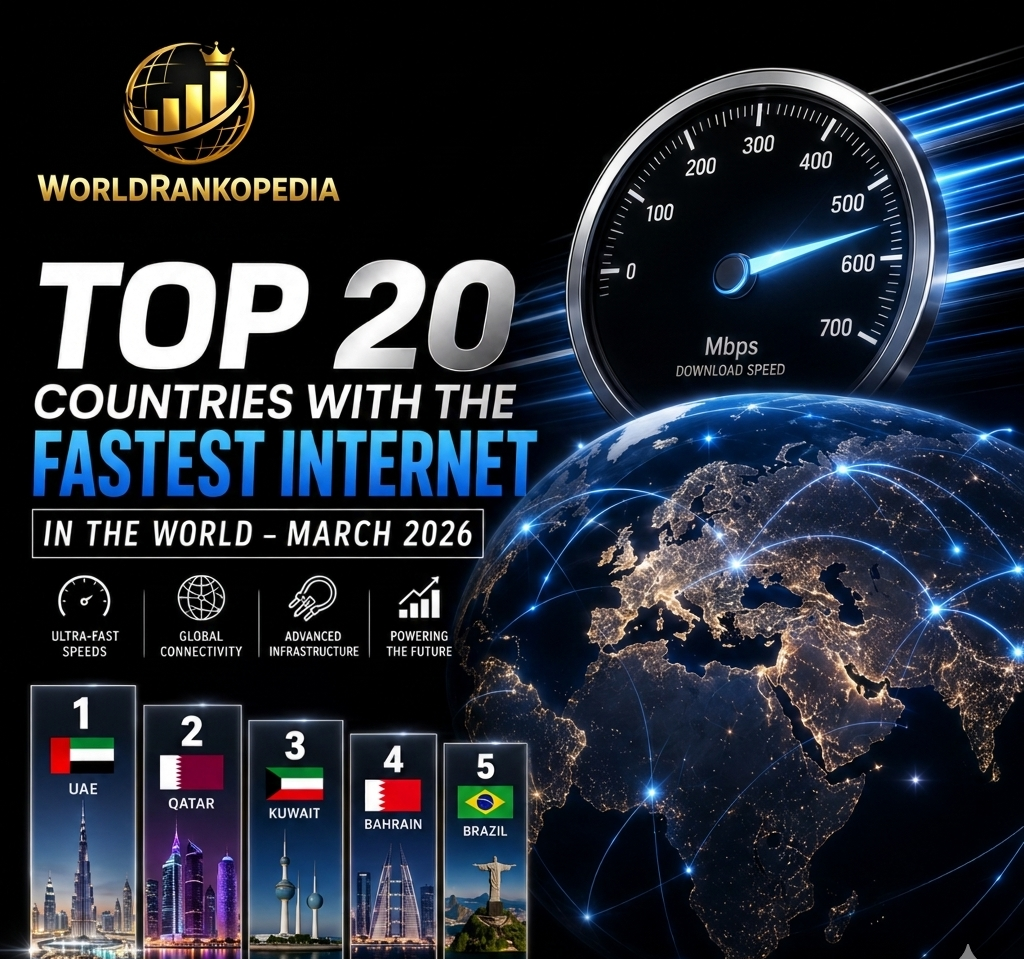
Top 20 Countries with the Fastest Internet – March 2026
Median Fixed Broadband Download Speed (Mbps)
| Rank | Country | Speed (Mbps) |
|---|---|---|
| 1 | UAE | 644.66 |
| 2 | Qatar | 576.06 |
| 3 | Kuwait | 372.76 |
| 4 | Bahrain | 274.94 |
| 5 | Brazil | 265.79 |
| 6 | South Korea | 265.20 |
| 7 | Brunei | 253.69 |
| 8 | Saudi Arabia | 226.53 |
| 9 | Bulgaria | 221.03 |
| 10 | United States | 213.29 |
| 11 | Vietnam | 200.54 |
| 12 | Singapore | 197.89 |
| 13 | Denmark | 192.16 |
| 14 | Estonia | 188.58 |
| 15 | Cambodia | 181.12 |
| 16 | Netherlands | 178.00 |
| 17 | Luxembourg | 173.19 |
| 18 | Oman | 169.87 |
| 19 | Norway | 167.28 |
| 20 | North Macedonia | 166.15 |
Gulf Countries Continue to Dominate
The United Arab Emirates remains the global leader with an incredible average download speed of 644.66 Mbps. Qatar follows closely behind with 576.06 Mbps, while Kuwait, Bahrain, Saudi Arabia, and Oman also secured positions in the top 20.
This dominance is largely due to massive investments in:
- Nationwide fibre-optic infrastructure
- Advanced 5G deployment
- Smart city projects
- Digital transformation strategies
Countries in the Gulf region have aggressively expanded Fibre-to-the-Home (FTTH) services over the past five years, giving millions of users access to ultra-fast internet connections.
With these speeds, users in the UAE can download massive files, stream 8K content, and play online games with almost no lag.
Brazil and Vietnam Surprise the World
One of the biggest surprises in the 2026 rankings is Brazil securing the 5th position with 265.79 Mbps. Vietnam also impressed by reaching 11th place with 200.54 Mbps.
These countries achieved rapid progress because of:
- Competitive telecom markets
- Affordable broadband pricing
- Government-backed fibre expansion
- Increased private investment
Brazil’s rise especially highlights how developing nations can quickly close the digital gap when infrastructure investment becomes a national priority.
Vietnam’s fast-growing tech industry and expanding urban connectivity also contributed heavily to its strong performance.
South Korea and Singapore Are Still Global Tech Leaders
For years, South Korea and Singapore were considered the gold standard for internet connectivity. While they no longer hold the top spots, both countries remain among the world’s fastest internet providers.
- South Korea ranked #6 with 265.20 Mbps
- Singapore ranked #12 with 197.89 Mbps
Both nations continue to benefit from:
- High urban density
- Strong telecom competition
- Advanced digital ecosystems
- Excellent public technology infrastructure
However, the Gulf region’s rapid 5G rollout and newer fiber networks have allowed Middle Eastern countries to overtake them in raw speed performance.
Europe’s Strong Presence in the Rankings
Several European countries also made the top 20 list, including:
- Denmark
- Estonia
- Netherlands
- Luxembourg
- Norway
- Bulgaria
Estonia stands out as a particularly interesting case. Despite its relatively small population, the country has become one of Europe’s most digitally advanced nations thanks to forward-thinking government policies and nationwide digital services.
Bulgaria’s appearance in the top 10 also surprised many observers, showing that internet performance is not limited to the world’s richest economies.
The United States Breaks into the Top 10
The United States ranked 10th globally with a median speed of 213.29 Mbps.
Although internet quality varies significantly across different states and cities, America’s national average continues to rise because of:
- Expansion of fibre internet services
- Growth of 5G mmWave networks
- Increased competition among ISPs
- Higher broadband demand
Major metropolitan areas like New York, Los Angeles, Dallas, and Chicago are driving the country’s strong performance.
Why Internet Speed Matters More Than Ever
Fast internet is no longer just about entertainment. It directly impacts economies, businesses, education systems, and healthcare.
For Everyday Users
High-speed internet allows users to:
- Download movies within seconds
- Stream 4K and 8K content smoothly
- Enjoy lag-free gaming
- Use smart home technologies efficiently
For Businesses
Modern businesses rely heavily on:
- Cloud computing
- AI systems
- Video conferencing
- Remote collaboration
- Large-scale data transfers
Without reliable high-speed internet, productivity suffers significantly.
For National Economies
Studies consistently show that faster internet boosts economic growth. Countries investing heavily in digital infrastructure are positioning themselves for success in industries like:
- Artificial Intelligence
- Fintech
- E-commerce
- Cybersecurity
- Smart manufacturing
How Internet Speeds Are Measured
The rankings are based on millions of real-world internet speed tests conducted by users worldwide.
The reported numbers represent median download speeds, meaning:
- Half of the users experienced faster speeds
- Half experienced slower speeds
This method provides a more realistic picture of actual user experience compared to telecom advertisements that often promote theoretical “maximum” speeds.
Where Does Pakistan Stand?
Pakistan did not make the top 20 list in March 2026. Current estimates place Pakistan’s median fixed broadband speed between 20 and 25 Mbps.
However, there are signs of progress.
Cities like:
- Lahore
- Karachi
- Islamabad
- Rawalpindi
- Sialkot
Are seeing increasing fibre-optic expansion and early-stage 5G testing.
If infrastructure investment continues and telecom competition improves, Pakistan could experience major internet speed improvements over the next few years.
The Future of Global Internet Speeds
The race for faster internet is becoming increasingly competitive.
Countries are now investing billions into:
- Fiber-optic expansion
- Satellite internet
- AI-powered network optimization
- 6G research
- Nationwide smart infrastructure
Emerging nations like Cambodia, Vietnam, and Brazil prove that rapid digital transformation is possible with the right policies and investment.
By 2027, the rankings could look completely different.