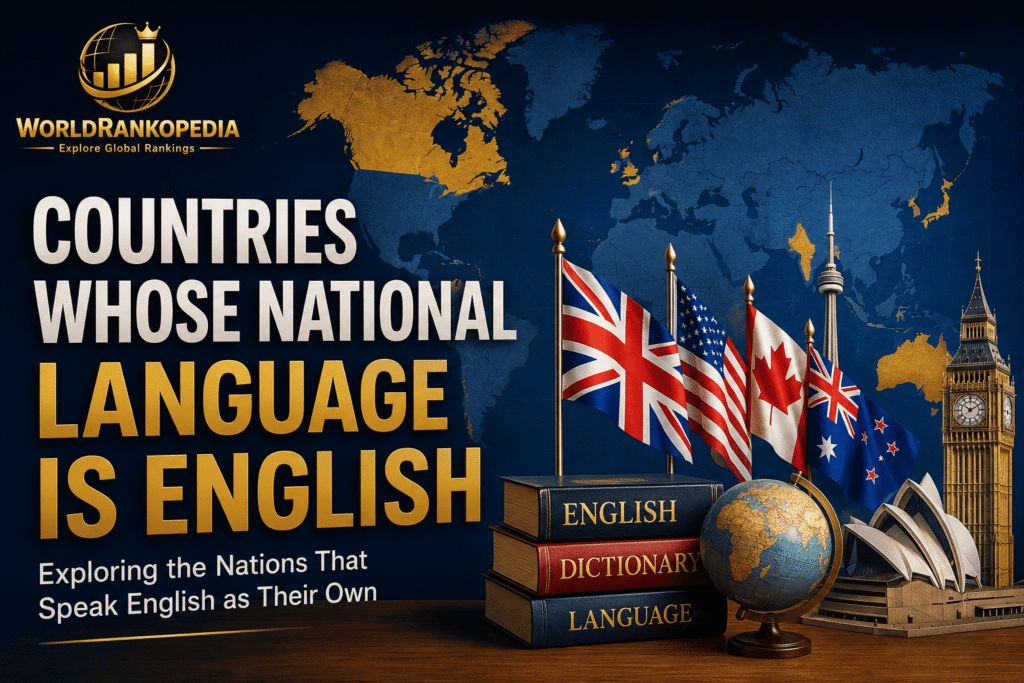
Countries Whose National Language Is English: A World United by Words
Published on WorldRankOpedia.com
Pick up your phone, open a browser, and search for almost anything — chances are, the first results that pop up are in English. Walk into an international airport in Tokyo, Lagos, or Buenos Aires, and the announcements overhead still ring out in English alongside the local tongue. It is the language of global diplomacy, air traffic control, scientific journals, and pop music. But have you ever stopped to wonder exactly which countries actually call English their official national language?
The answer might surprise you. There are far more countries than most people assume — and the stories behind how English ended up there are fascinating.
More Than Just the UK and the USA
Most people instinctively picture Britain or America when they think of English-speaking nations. And yes, both the United Kingdom and the United States are among the world’s most prominent English-speaking countries — though interestingly, the US does not have an official national language enshrined at the federal level. English functions as the de facto language, spoken by the vast majority, but it has never been formally designated in the constitution.
The United Kingdom, on the other hand, is widely recognized as the birthplace of modern English. From England to Scotland, Wales to Northern Ireland, English serves as the primary medium of communication across government, education, and daily life — even as Welsh, Scots Gaelic, and Irish hold their own official status in their respective regions.
The Commonwealth Connection
A large portion of the world’s English-speaking nations share one common thread: the British Empire. At its peak in the early 20th century, Britain controlled roughly a quarter of the Earth’s land surface. As it withdrew, it left behind legal systems, educational institutions, and — crucially — language.
Canada is officially bilingual, with both English and French holding national status. But English dominates in most provinces and serves as the primary working language for business, government, and culture outside of Quebec.
Australia and New Zealand both have English as their de facto national language. While neither country has formally written English into law as its sole official language, it functions universally in all official capacities and is spoken as a first language by the overwhelming majority.
South Africa takes a uniquely democratic approach to language — it recognizes eleven official languages, with English being one of them. Despite not being the most widely spoken language at home (Zulu and Xhosa hold that crown), English remains the language of government proceedings, business, and higher education.
Island Nations and Small States
Some of the most interesting English-speaking countries in the world are also the smallest. Scattered across the Caribbean, the Pacific, and the Atlantic are dozens of island nations where English is either the sole or primary official language.
Jamaica, Barbados, Trinidad and Tobago, the Bahamas, Belize, and Grenada are just a few Caribbean nations where English is the official tongue — each with its own vibrant local dialect that gives the language color, rhythm, and soul that no textbook could ever capture.
In the Pacific, countries like Fiji, Papua New Guinea, the Solomon Islands, Vanuatu, and Samoa list English among their official languages — often alongside indigenous languages and regional creoles that better reflect the cultural complexity of these island communities.
Malta, sitting in the heart of the Mediterranean, is one of the few European nations outside the British Isles with English as an official language, a legacy of British colonial rule that ended in 1964.
Africa’s English-Speaking Nations
Africa is home to some of the most linguistically diverse countries on Earth, and yet English plays a major administrative and unifying role across much of the continent — particularly in sub-Saharan Africa.
Nigeria, Africa’s most populous nation, uses English as its official language to bridge communication across more than 500 local languages and ethnic groups. Ghana, Kenya, Tanzania, Uganda, Zambia, Zimbabwe, Sierra Leone, Liberia, and Botswana are among the many African nations that have adopted English in an official capacity.
In Rwanda, an interesting modern shift occurred: in 2008, the government switched from French to English as a primary language of instruction in schools — a deliberate, forward-looking move to better connect the country to global economic and educational opportunities.
Asia’s English-Speaking Countries
India — with its staggering diversity of over 1,600 languages — uses both Hindi and English as its two official languages at the national level. English was retained after independence in 1947 as a practical lingua franca to hold together a nation that speaks dozens of mutually unintelligible tongues.
Pakistan similarly designates English alongside Urdu. In law courts, universities, and federal government institutions, English remains deeply embedded.
Singapore is perhaps the world’s most striking example of English adoption in Asia. A city-state with four official languages — English, Mandarin, Malay, and Tamil — English serves as the administrative language and the primary medium of education. Singaporean English has even evolved its own beloved local dialect: Singlish.
The Philippines lists both Filipino (Tagalog) and English as official languages, a legacy of American colonial rule. English is used widely in media, education, and government.
So, How Many Countries Is That?
By most counts, approximately 67 countries around the world recognize English as an official or co-official language. When you factor in territories and dependencies, that number climbs even higher. English is spoken as a first language by roughly 400 million people — and as a second or additional language by well over a billion more.
A Language That Keeps Expanding
What makes English remarkable is not just its reach, but its resilience and adaptability. Every country that adopted it made it their own. Nigerian English, Jamaican Patois, Singlish, Indian English — these are not corruptions of some pure original. They are living proof that language bends and blooms wherever people use it to connect, create, and communicate.
From a small island in the North Atlantic, English traveled the world on merchant ships and colonial flags. Today, it travels on the internet, in classrooms, boardrooms, and football stadiums. It belongs to everyone who speaks it — and that, at last count, is quite a lot of people.
Explore more world language facts, country rankings, and global trivia at www.worldrankopedia.com