In the global economy, not all currencies are created equal. While many people assume the US Dollar or the euro is the world’s strongest currency, the reality is quite different. Some smaller nations with stable economies, massive oil reserves, strong banking systems, or global financial influence have currencies worth far more than one US Dollar.
Currency strength is usually measured by how much one unit of a currency is worth against the US Dollar (USD). A stronger currency often reflects economic stability, investor confidence, low inflation, and strong financial management.
What Makes a Currency Strong?
Before diving into the rankings, it’s important to understand what gives a currency its strength. Several factors influence a currency’s value:
- Strong and stable economy
- High foreign reserves
- Low inflation rates
- Political stability
- Oil and natural resource exports
- Strong banking and financial systems
- Investor trust
- Fixed exchange rate policies
Some countries intentionally keep their currency strong to support imports and maintain economic confidence.
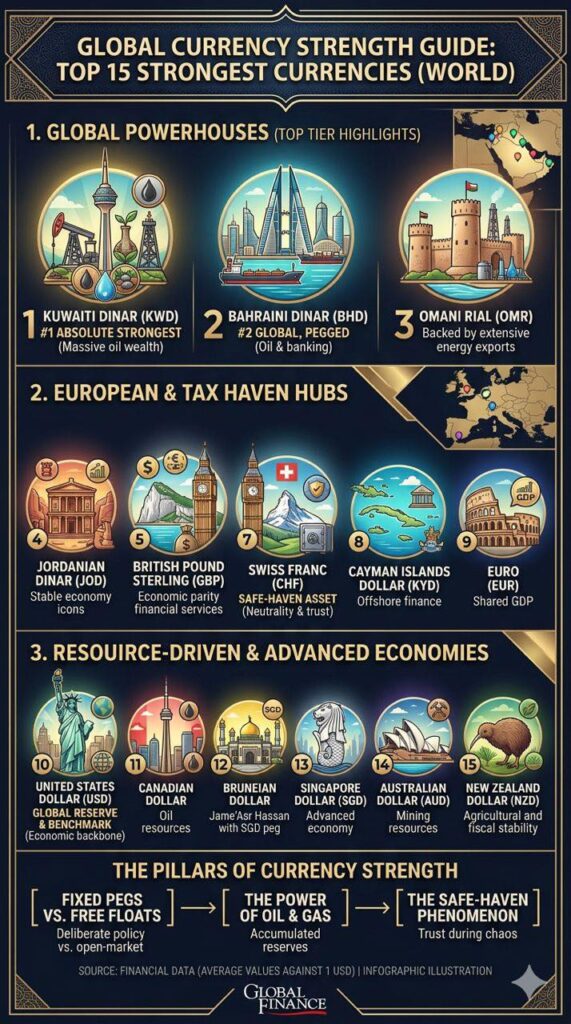
Top 15 Strongest Currencies in the World (2026)
1st is Kuwaiti Dinar (KWD)


The Kuwaiti Dinar remains the strongest currency in the world. Kuwait’s massive oil exports and relatively small population create enormous wealth per citizen. The country also maintains strong financial reserves and economic stability.
Why It’s Strong:
- Huge oil revenues
- Stable economy
- Strong sovereign wealth fund
- High GDP per capita
2nd is Bahraini Dinar (BHD)


Bahrain’s currency is one of the highest-valued in the world. The nation benefits from oil exports, strong banking services, and a currency pegged to the US Dollar.
Key Strengths:
- Financial hub in the Gulf
- Oil and gas revenues
- Stable monetary policy
3rd is Omani Rial (OMR)


Oman’s strong energy sector and stable governance have helped the Omani Rial maintain one of the highest values globally.
Why Investors Trust It:
- Energy exports
- Controlled inflation
- Stable political environment
4th is Jordanian Dinar (JOD)


Despite limited natural resources, Jordan has maintained a surprisingly strong currency due to careful monetary policy and financial stability.
Major Factors:
- Stable banking system
- Strong monetary management
- International support and investment
5th is British Pound Sterling (GBP)


The British Pound is one of the oldest and most traded currencies in the world. London remains a major global financial centre.
Why It Remains Powerful:
- Strong financial markets
- Global investor confidence
- Historic international influence
6th is Gibraltar Pound (GIP)
The Gibraltar Pound is pegged to the British Pound and benefits from Gibraltar’s financial services and tourism industry.
Key Strengths:
- Linked to GBP stability
- Strong financial regulations
- Tourism-based economy
7th is Swiss Franc (CHF)


The Swiss Franc is widely considered a “safe-haven” currency. During economic crises, investors often move their money into Swiss assets.
Why CHF Is Trusted:
- Political neutrality
- Strong banking sector
- Low inflation
- Stable economy
8th is Cayman Islands Dollar (KYD)
The Cayman Islands Dollar is supported by one of the world’s largest offshore financial centres.
Major Reasons:
- Strong offshore banking industry
- Stable economy
- High international financial activity
9th is Euro (EUR)


The Euro is the official currency of many European nations and is among the world’s most traded currencies.
Strength Drivers:
- Massive combined economy
- Global trade importance
- Strong central banking system
10th is the United States Dollar (USD)


Although not the highest-valued currency per unit, the US Dollar is the world’s dominant reserve currency.
Why USD Dominates:
- Global trade benchmark
- Largest economy
- Trusted reserve asset
- Oil trading currency
11th is the Canadian Dollar (CAD)
Canada’s currency benefits heavily from oil, gas, and natural resource exports.
Main Advantages:
- Stable banking sector
- Resource-rich economy
- Strong trade ties with the US
12th is the Brunei Dollar (BND)
The Brunei Dollar is highly stable due to the nation’s oil wealth and strong link with the Singapore Dollar.
Highlighted Factors:
- Oil and gas reserves
- Wealthy economy
- Strong currency agreement with Singapore
13th is Singapore Dollar (SGD)


Singapore has transformed into one of Asia’s biggest financial hubs. Its currency reflects economic discipline and investor confidence.
Why SGD Is Strong:
- Advanced economy
- Strong financial system
- Strategic trade location
14th is the Australian Dollar (AUD)
Australia’s currency benefits from mining exports, especially iron ore and natural resources.
Major Strengths:
- Commodity exports
- Strong economic governance
- Stable financial sector
15th is the New Zealand Dollar (NZD)
The New Zealand Dollar is supported by agriculture, exports, and stable fiscal policies.
Highlighted Advantages:
- Strong agricultural sector
- Political stability
- Trusted economy
Why Oil-Rich Countries Dominate Currency Rankings
One major trend is clear: oil-rich Gulf nations dominate the top positions. Countries like Kuwait, Bahrain, and Oman generate enormous export revenue through oil and gas.
This creates:
- High foreign currency reserves
- Strong trade balances
- Economic confidence
- Stable government income
Because of this, their currencies remain extremely valuable against the US Dollar.
Safe-Haven Currencies Explained
Currencies like the Swiss Franc and US Dollar are considered “safe-haven” currencies. During wars, recessions, or financial crises, investors move money into these currencies because they are seen as stable and reliable.
This increases demand and helps maintain their strength.
Does a Strong Currency Mean a Rich Country?
Not always. A strong currency does not automatically mean a country has the world’s largest economy.
For example:
- The US has the largest economy, but its currency is not the highest-valued per unit.
- Smaller Gulf nations have stronger exchange rates due to limited currency supply and high oil wealth.
Currency strength reflects value per unit, not overall economic size.
Final Thoughts
The world’s strongest currencies are backed by a mix of oil wealth, stable governments, smart financial policies, and global investor trust. While the US Dollar dominates international trade, smaller nations like Kuwait and Bahrain maintain the highest currency values.
As global markets continue evolving in 2026, currency strength will remain closely linked to economic stability, energy exports, and financial confidence.
For more global rankings, economic insights, and international comparisons, visit World Rankopedia.