Obesity is a huge health issue worldwide these days. It used to be mostly a problem for richer countries, but now it’s growing fast everywhere, both in wealthy and developing nations. Data from the World Health Organisation (WHO) and World Population Review for 2022 shows that millions of adults globally are dealing with it. This is happening because our lives have changed a lot: we’re eating less healthy, moving less, living more in cities, and relying more on packaged foods.
Usually, doctors say someone is obese if their Body Mass Index (BMI) is 30 or more. Being obese really ups your chances of getting serious health problems like heart disease, diabetes, high blood pressure, strokes, and even some types of cancer.
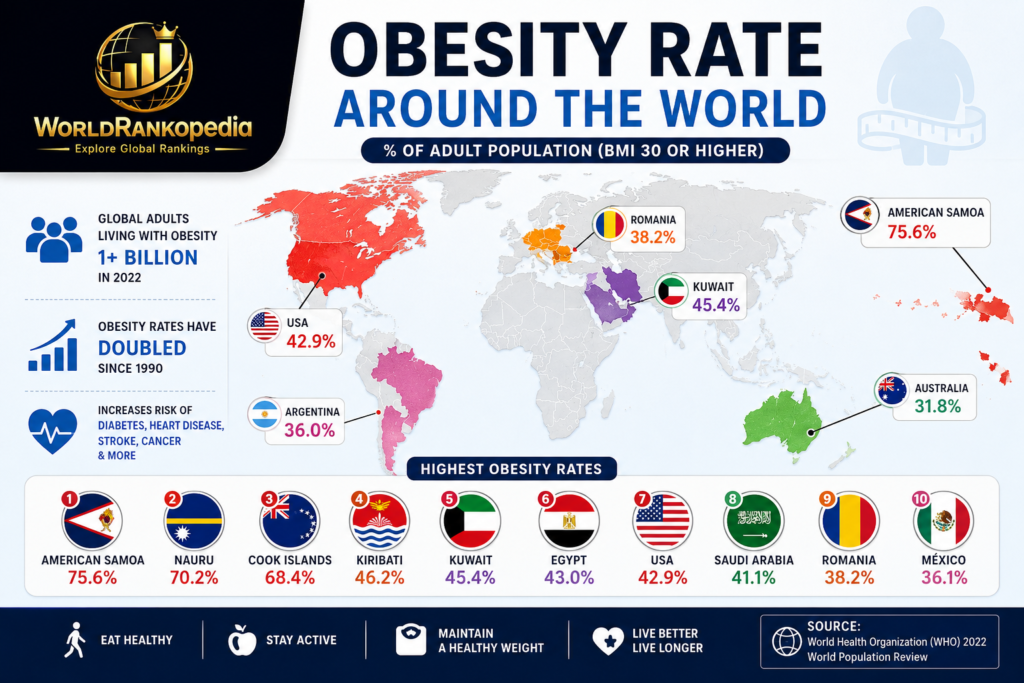
The WHO also reported that in 2022, over a billion people around the globe were obese. What’s more, adult obesity rates have shot up to more than double what they were back in 1990.
American Samoa leads the list with an obesity rate of 75.6%. This little island nation in the Pacific is really struggling with health issues tied to obesity. Experts point to a major reason: people quickly shifted from traditional diets to eating a lot of processed, imported foods. On top of that, not enough physical activity and a lot of sugary drinks and fast food have made the problem much worse.
Next is Nauru, at 70.2%. Nauru has been dealing with obesity and diabetes for a long time. Their old ways of life, like fishing and farming, have given way to relying on imported foods packed with sugar and fat. Even though Nauru has a small population, it’s facing some of the worst rates of obesity-related sicknesses in the world.
The Cook Islands are another place with a very high number of obese people worldwide, with a rate of 68.4%. More processed foods and less physical activity are part of the problem. Like a lot of other Pacific island nations, the way people eat has changed hugely in recent decades as things have become more modern.
Kiribati faces a growing obesity problem at 46.2%. This is mainly because fresh, healthy food is hard to come by, and people are increasingly turning to imported canned and packaged meals. More city living and not much exercise also play a huge role.
Kuwait has one of the highest obesity rates in the Middle East, at 45.4%. People there tend to live inactive lives, and the hot weather often limits outdoor activities. Eating a lot of fast food also adds a lot to the high obesity numbers. On top of that, diabetes and heart disease are quite common across the country.
Egypt has seen obesity rates climb significantly over the last twenty years, reaching 43.0%. Fast food, sugary drinks, and people not being very active are common reasons for this. It’s worth noting that women in Egypt seem to be particularly affected by obesity, more so than in many other places.
The United States is still one of the most obese countries globally, with 42.9% of its population affected. Big meal sizes, the whole fast-food culture, lots of processed meals, and inactive lifestyles have all helped create this problem. It’s also estimated that obesity-related healthcare costs in the U.S. reach billions of dollars every single year.
Saudi Arabia has experienced rising obesity rates, now at 41.1%. This is thanks to people living city lives, getting less exercise, and eating diets high in calories. Spending more time on screens and using cars instead of walking are also big reasons.
Romania has one of Europe’s highest obesity rates at 38.2%. Experts say this is tied to poor eating habits, more and more people eating processed foods, and generally less physical activity.
Mexico has been fighting obesity for a long time, with a rate of 36.1%. A big part of the problem is how many soft drinks people consume and their unhealthy eating habits. To tackle this, the country has started using sugar taxes and launched campaigns to make people more aware.
Beyond these top few, many other nations also grapple with high obesity rates. For instance,
Argentina has a rate of 36.0%,
Turkey 34.3%,
New Zealand 34.2%,
Greece 33.7%.
Australia is at 31.8%,
The UAE at 31.5%,
Poland 31.4%,
Czechia 31.3%.
Ireland shows 30.8%,
South Africa 30.0%,
El Salvador 29.9%,
Ukraine 29.2%.
Brazil has 28.8%,
The United Kingdom 28.7%,
Russia 28.0%,
Canada 27.3%.
Serbia is at 26.1%,
Germany 24.2%,
Finland 23.7%,
Israel 23.4%,
Belgium 22.0%,
Pakistan 21.8%.
On the other hand, some countries have very low obesity rates. Vietnam, for example, has one of the lowest rates anywhere, at 2.1%. This is largely because their traditional diet is full of fresh ingredients like vegetables and seafood. Plus, people walk a lot and generally lead active lives, which helps them stay at a healthy weight.
Ethiopia also has low obesity rates, at 2.4%. This is partly because people don’t eat a lot of processed food and tend to live more active lives.
Japan, at 4.9%, is known for its balanced diet, smaller meal sizes, and active lifestyle. Traditional Japanese food usually features a lot of fish, rice, vegetables, and fermented items.
Bangladesh also keeps its obesity rates fairly low compared to many other countries, at 5.3%. This comes from people eating less processed food and having different traditional diets.
South Korea, with a 6.7% rate, benefits from diets packed with vegetables, fermented foods, and seafood. Plus, walking and using public transport means people are generally more active.
So, why is obesity becoming such a big deal everywhere? A few global things are driving this. We’re seeing more fast food and sugary drinks being consumed, and lots of us rely on processed foods. Many jobs mean sitting all day, leading to less physical activity overall. More and more people are living in cities, and we’re spending a lot more time looking at screens. Even stress and not getting enough sleep also play a part. The WHO warns that obesity is now one of the top global public health worries.
Being obese can lead to a bunch of dangerous health issues. These include Type 2 Diabetes, Heart Disease, High Blood Pressure, Strokes, Sleep Apnea, and various joint problems. It can also increase the risk for certain cancers and mental health issues. In fact, WHO research shows that illnesses linked to obesity are responsible for millions of deaths around the world every year.
Around the world, governments are trying out different ways to fight obesity. They’re doing things like taxing sugary products, running campaigns to promote healthy eating, and creating fitness programs for schools. They’re also making food labels clearer, limiting ads for junk food, and starting public initiatives to encourage exercise. Some countries are pushing for healthier school meals and trying to get citizens to live more active lives.
Pakistan’s obesity rate is currently 21.8%. That’s lower than many Western countries, but it’s still something to be concerned about. City living, a growing fast-food culture, and less physical activity are causing obesity rates to steadily go up, especially in big cities like Karachi, Lahore, and Islamabad. Health experts warn that if they don’t take preventive actions soon, Pakistan could see a major increase in diabetes and heart disease.
Obesity isn’t just a problem for rich countries anymore. It’s become a global health crisis, affecting nations on every continent. Right now, Pacific island countries have the highest obesity rates. Meanwhile, many Asian countries are still managing to keep their rates low, largely because of their traditional diets and active lifestyles. As processed foods get more common worldwide, governments and individuals face a big challenge: how do we balance convenience with living healthier? The future of global health will largely depend on how effectively countries can tackle this growing obesity issue.
This information comes from data by the World Health Organisation (WHO) and World Population Review.